Get Full Government Meeting Transcripts, Videos, & Alerts Forever!
Get email alerts on the Zoning Overlay topic
No spam. Unsubscribe anytime.
Whitehall staff, petition committee present revisions and case studies for Fairway Boulevard overlay
Summary
City staff and a petition committee discussed how a proposed Fairway Boulevard overlay district would change lot‑split rules, housing types, short‑term rental rules and tree protections; the petition committee said it will submit a redlined modified ordinance during the reconsideration period.
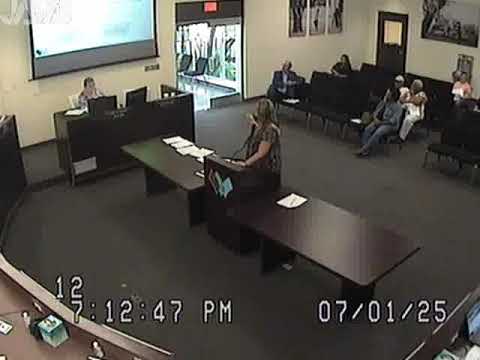
Director of Economic Development Russell presented a set of case studies Tuesday evening to show how the proposed Fairway Boulevard overlay district would operate and how it would differ from the city’s current zoning code.
Russell told the Whitehall City Council the overlay would cover about 141 parcels and change several technical rules that govern lot splits, frontage and permitted building types. "So tonight we're gonna walk you through, example case studies of what could occur on a lot and the repercussions of them," she said during a slide presentation.
Under current city code, lots larger than 1 acre generally require a trip to the Planning Commission and a recorded legal description; the proposed overlay adds a 200‑foot frontage requirement and would leave only two parcels (parcel endings 1764 and 1772) eligible for division under the frontage rule, Russell said. She said a parcel with roughly 226 feet of frontage would face a 200‑foot setback under the overlay. Russell also said the overlay would limit new house types on a lot to a single detached house; duplexes and townhomes would not be allowed on parcels inside the overlay as currently drafted.
The presentation said accessory dwelling units (ADUs) would remain permitted but would continue to be handled through the special‑use permit process that requires Planning Commission review and notification to neighbors. Short‑term rentals such as Airbnb and VRBO currently require a special‑use permit under existing code, Russell said; the overlay text drafted by the initiative petition would remove short‑term rentals as a permitted use in the overlay. Bed‑and‑breakfast operations, by contrast, were not removed from the overlay text and would remain subject to the special‑use process.
Russell said the overlay text would protect trees and shrubs that are located in public rights of way tied to road, sidewalk or shared‑use‑path projects; the overlay would disallow removal of right‑of‑way trees except when the director of public service determines a health or safety hazard. Non‑right‑of‑way trees would remain without an explicit replacement requirement in both the current code and the proposed overlay, she said.
A member of the petition committee told council that the committee had produced a revised draft and would submit a redlined, modified ordinance during the charter’s reconsideration period. "We will be submitting a modified ordinance with those changes, redlined for you to look at," the petitioner said, adding that the modification carried the signatures of all five committee members.
Council members and staff discussed several technical ambiguities that staff said they would continue to refine, including how to treat private roads and driveways, how construction impacts the health of large trees, and how separate entrances for a mother‑in‑law suite would be classified. Russell urged council members to submit questions in advance of a committee meeting slated for next week so staff could research answers. The council previously postponed third reading of Ordinance 42‑20‑25 to July 15, 2025, according to the agenda.
The petition committee and staff said they had visited Millbrook Farm Subdivision as a case study, and staff said a second concept plan from the committee was under analysis and would be provided to council as it becomes available. Russell said staff and the petition committee had been meeting informally and hoped to resolve language issues that would aid implementation.
The presentation and the committee’s statement set expectations that further edits are possible during the reconsideration period but did not reflect a final council action; Russell and the petition committee asked the council to review forthcoming materials before the next committee meeting.