
Board denies application for private event venue after neighbors and code enforcement raise complaints
Get AI-powered insights, summaries, and transcripts
Subscribe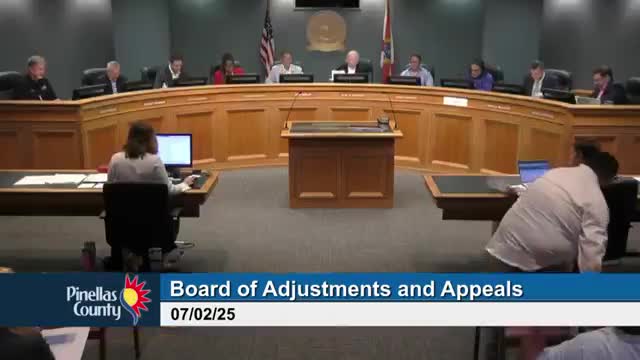
Summary
Pinellas County denied a Type 2 use for an event venue at 9551 Ninetieth Avenue North after opponents cited noise, parking and advertising without permits; code enforcement has a pending citation and a July 30 hearing.
The Pinellas County Board of Adjustment and Appeals voted unanimously June 4 to deny a Type 2 use that would have allowed events at a private residence at 9551 Ninetieth Avenue North in unincorporated Seminole.
Staff presented the request as a proposed meeting‑hall/community assembly use on roughly 1.79 acres where the existing detached single‑family residence would host weddings, baby showers, reunions and limited corporate gatherings. Staff recommended conditional approval with detailed operational limits on the number of attendees, hours, parking and temporary‑event clearances.
Applicants Lauren Monas and Ronald Vigneault said they operate the property primarily as a vacation rental and sought the Type 2 approval to allow occasional controlled events. “We don’t want to be an event venue because we’re not gonna, like, rent chairs or tents,” Monas told the board, describing planned controls: valet parking, a decibel meter, preferred vendors and limits on tents. The applicants proposed a typical cap of 50 people for weddings and suggested up to six weddings per year as a likely maximum.
Opponents — including attorney Brian Angst speaking for adjacent owners, neighbors such as Al O’Donnell and Maurice Osborne, and Code Enforcement Officer Sheena Patrick — urged denial. Angst told the board the property had been used as an event venue without approval and that advertising marketed capacities well above what the applicants sought at the hearing: “The applicants are advertising events up to 150 people,” Angst said, adding that short‑term rental marketing advertised 28 overnight occupants while county code limits such residential occupancy to 10 under short‑term rental rules.
Officer Patrick testified that code enforcement issued warning notices after investigating advertising and event activity and that a fine and a pending enforcement hearing were scheduled for July 30. She said staff found continued advertising and activity without zoning approval.
Neighbors described repeated late‑night noise, multiple sheriff calls and parking blocking driveways on the dead‑end road. Maurice Osborne said sound vibrated the windows of his house during events; Al O'Donnell said his family had repeatedly called law enforcement. Several neighbors also reported vendor vehicles, temporary parking in front yards, and public urination near events.
Board members focused their discussion on the Type 2 approval criteria: consistency with the comprehensive plan and zoning (the property is in a residential estate zoning district), adequate separation and buffering from adjacent residences, and sufficient on‑site parking and circulation for events. Multiple board members said the proximity of neighboring homes and the dead‑end street raised safety and nuisance concerns. One member noted that staff’s proposed buffering and parking arrangements did not, in their view, resolve the proximity of event spaces to adjacent backyards.
A motion to deny found that the application failed to meet criteria a (consistency with zoning and the comprehensive plan), b (adequate separation/buffering), and c (adequate drives, walkways and parking). The motion passed unanimously. Staff noted that if events are held in the future they must obtain required temporary‑event zoning clearances and fire review as applicable; the denial preserves those code requirements and leaves enforcement action pending for the citations already issued.
Key factual clarifications recorded during the hearing: the staff report described the property as approximately 1.79 acres; the applicants said they had hosted several events in prior years (they estimated about six over two years); code enforcement confirmed advertising for higher capacities remained online in places and that staff issued warning notices and fines. The board limited its decision to the Type 2 use criteria; short‑term rental compliance and other code enforcement matters remain separate processes handled by county staff and the pending enforcement hearing.