
Martin County utilities announce biannual chlorination; officials say water remains safe
Get AI-powered insights, summaries, and transcripts
Subscribe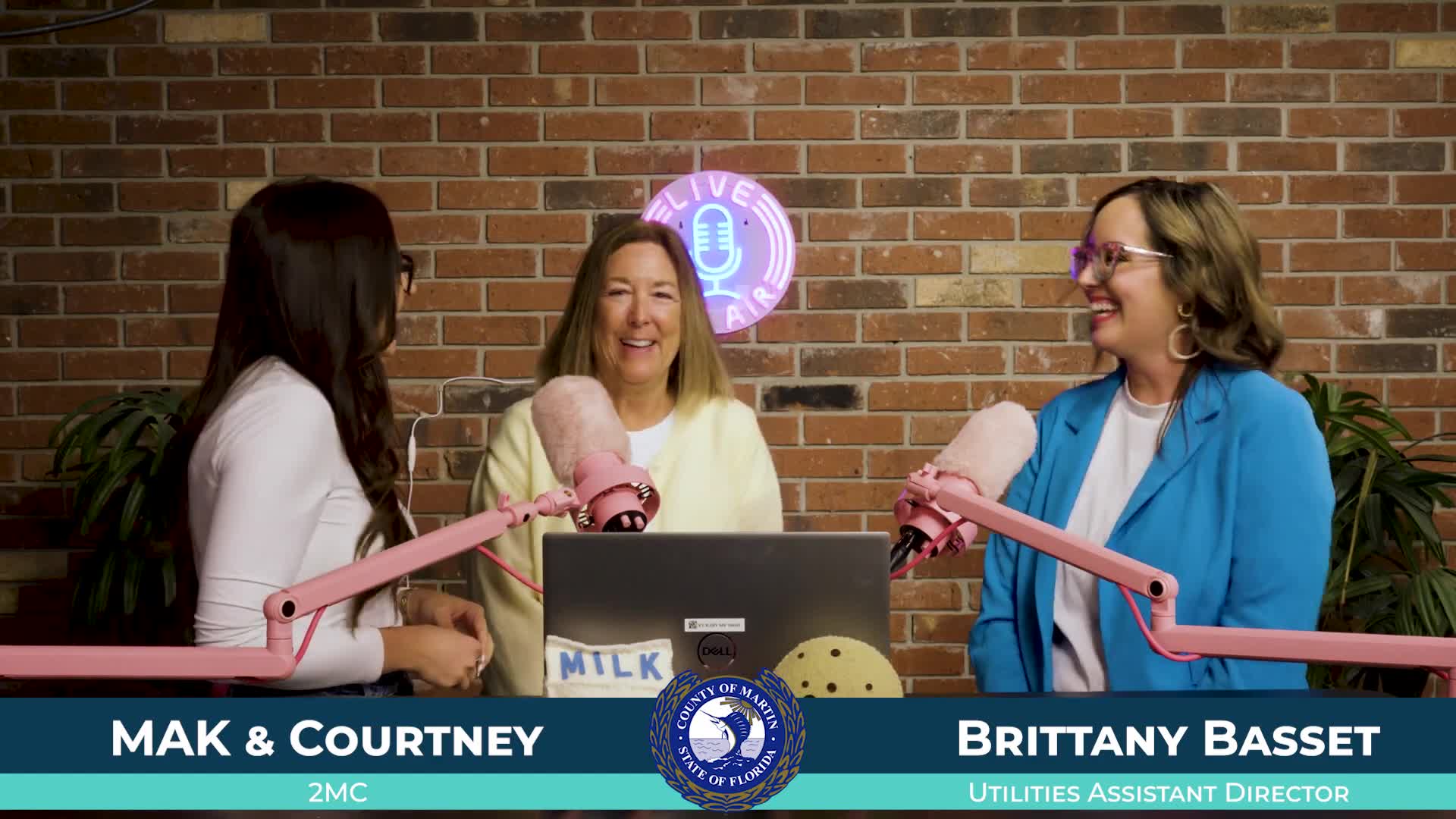
Summary
Martin County utilities will begin a scheduled, biannual chlorine maintenance in the distribution system on Sunday, July 6, running for about two weeks, Assistant Utilities Director Britney Bassett said.
Martin County utilities will begin a scheduled, biannual chlorine maintenance in the county distribution system on Sunday, July 6, running for about two weeks, Assistant Utilities Director Britney Bassett said on the Martin County podcast. Bassett told listeners the maintenance is a routine public-health measure and that residents may notice a change in taste but should expect the water to remain safe.
The maintenance, described by Bassett as a “chlorine maintenance” program, is performed to protect public health across the distribution network. “It is still safe. That is our number one goal,” Bassett said. She added that South Martin Regional Utilities and the City of Stuart plan to do the work at the same time.
The county also released its 2024 drinking water quality report, Bassett said. The report, she said, lists detected analytes, explains their sources and describes future projects; the utilities department made a simplified table so consumers can see which substances were measured and where samples came from.
Bassett described the sources and treatment steps Martin County uses for drinking water. The county draws from two aquifers: shallower surficial wells about 100–150 feet below land surface and deeper Floridan aquifer wells around 1,300 feet below land surface. Water from the Floridan aquifer has higher salinity and is treated with reverse osmosis; staff then blend that treated (permeate) water with surficial-well water and add minerals back to stabilize hardness and alkalinity.
The department highlighted its laboratory sampling and treatment practices and said those steps are part of efforts that led to a regional award: Martin County Utilities won the 2025 Region 8 “best tasting drinking water” contest. Bassett said the department will compete in December at the Florida Section American Water Works Association fall conference against 14 other regions.
Wastewater treatment and reuse also featured in the discussion. Bassett said the county treats domestic sewage to reclaimed-water standards for reuse, supplying irrigation water for golf courses and other nonpotable needs “to eliminate stress on the potable wells.” She described wastewater treatment as primarily a biological process and drinking-water treatment as chemical/physical processes, and reiterated that laboratories monitor disinfectant levels and other parameters as part of public-health protection.
Where to find more: Bassett and the podcast hosts said the county’s 2024 drinking water quality report and notices about the chlorination schedule will be posted in the episode show notes and on the utilities page. Residents who notice an unusual taste were advised the change is expected and temporary during the maintenance period.
Britney Bassett, assistant utilities director, was the county official quoted in the interview. Other speakers on the episode were podcast hosts (identified as Courtney and Mac).