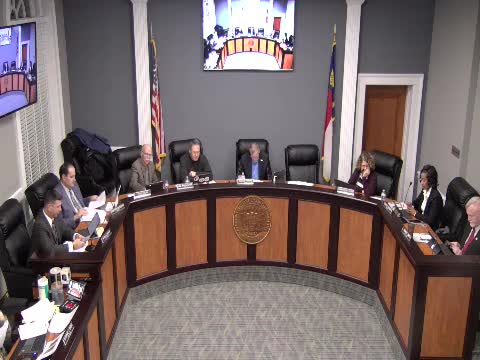
Gastonia council awards $571,388 contract to build real‑time crime center, approves federal grant spending
Loading...
Summary
The Gastonia City Council voted to award a $571,388.53 contract to Relevant AV Solutions to equip a real‑time crime center at police headquarters, funded through a federal COPS grant. Officials outlined staffing, cameras, and software plans and said the center aims to improve situational awareness and help officers solve crimes faster.
The Gastonia City Council voted to award a $571,388.53 contract to Relevant AV Solutions to establish a real‑time crime center at the police department, using funds from a federal Community Oriented Policing Services (COPS) grant.
The center will gather and analyze surveillance and intelligence — including license‑plate readers, gunshot detection and other sensors — on a wall of monitors and individual consoles to provide officers and analysts with real‑time situational awareness, Research Analysis and Accreditation Administrator Tanya Taylor said during a presentation to the council. Taylor said the room’s software will be the core driver of the center’s functions.
Taylor told council members the center’s goals include strengthening community safety, producing timely public alerts and dashboards, assisting officers in the field, locating missing people, and improving allocation of resources. She said the project combines several funding sources: $571,388.53 for the mission‑critical AV, consoles and software (COPS grant), $66,000 already spent for 22 Condor cameras (COPS grant), $97,500 for Flock OS wings and professional services (COPS grant), and $220,000 in construction funds from ARPA and the general fund for an earlier design‑build contract.
Council members asked for details about staffing, ongoing operating costs and civil‑liberties protections. Taylor said the department has requested four positions in the fiscal year 2026 budget to staff the center; the initial operations plan calls for a single first shift during the first 90 days before expanding to second shifts and then a full seven‑day operation in a later budget year. She said sworn and non‑sworn personnel — crime analysts, a sergeant and an RTCC manager — will staff the room and that cameras will remain operational 24/7 even while staffing phases in.
Taylor said the system will integrate Flock OS software, video walls (two rows of eight 55‑inch LED screens), consoles, raised flooring for cabling, wireless conferencing, and space renovations that include removing ceiling tiles and installing a glass partition so tours can observe without interrupting operations. She described planned integration points such as video from police drones and from third‑party “Gas and Go” vans, and said some drone automation (Aerodrome capability) could be added later pending Federal Aviation Administration approvals.
On privacy and civil liberties concerns, Taylor said access to cameras and the RTCC systems will be encrypted, password protected and limited to authorized, trained staff. She said analytic tools and AI in the Flock OS environment are search features that analysts will use to find vehicles or characteristics; the system will not be used for generalized surveillance of lawful activity.
After the presentation and discussion, a council motion to approve the Relevant AV Solutions contract carried unanimously.
Council members said the center could speed investigations, help find missing people and improve officer safety. Taylor said construction work and equipment installation will proceed in coordination with the design‑build contractor (Quinn Sells/Quincells in the project papers) and that the city hopes for a ribbon‑cutting in summer 2025.