
Fire chief: swift‑water rescues expose need for clearer river signage and public education
Get AI-powered insights, summaries, and transcripts
Subscribe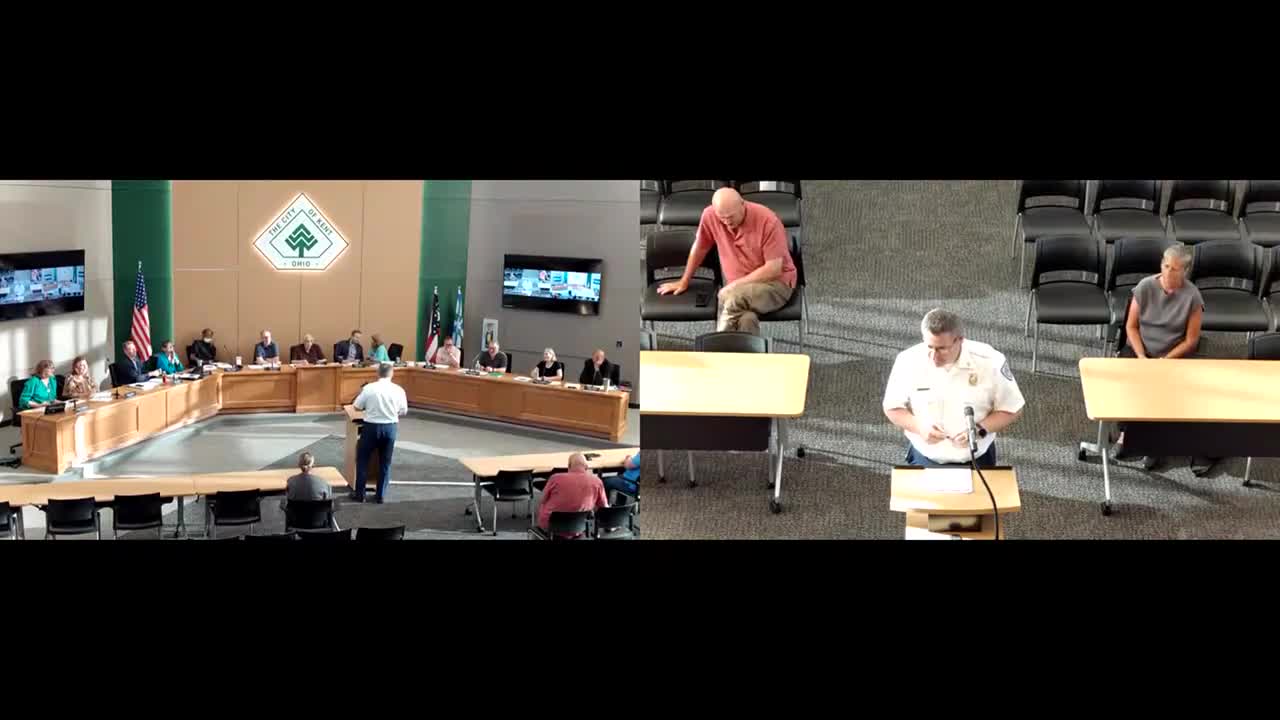
Summary
Kent Fire Department said a busy, high‑water weekend produced multiple swift‑water rescues; the department plans additional scouting, coordination with neighboring agencies and clearer signage, including a potential QR code that would link to current river flow data.
Kent’s fire chief reported to Council that a hot, rainy spell produced very high river flows and stretched the department’s water‑rescue resources during a recent weekend, and he urged better public education and clearer signage at common put‑in sites.
Chief Jamie (Fire Chief) said the department’s on‑duty crew responded to an afternoon incident in which a group struck a submerged, downed tree and was flipped off rafts; rescuers worked with Portage County teams and neighboring fire departments to retrieve the group. “We were out there and we pounced on it,” Jamie said, describing three boats with trained swift‑water rescue swimmers and life jackets used to locate and retrieve 11 people and two dogs. In total, Jamie said the department assisted 23 people who needed help and rescued or aided another 28 people who were uncontrolled but not in immediate danger. He said no rescuers were injured and no one in the public suffered serious injury.
The chief said the department had posted signs and used social media before the weekend to warn about high flows, and that he issued a press release afterward to explain the scope of the incident and encourage life‑jacket use. He referenced the recent fatality in nearby Cuyahoga Falls as a motivating factor for more public outreach.
Council members and staff discussed signage content and consistency with commercial outfitters. Jamie and other staff said they want to coordinate messaging with local outfitters so posted guidance does not conflict with private operators’ safety advice. Jamie suggested adding real‑time links or a QR code to let users see the Cuyahoga River’s current cubic‑feet‑per‑second flow; he said department crews use a flow readout in their daily checks and that the day of the rescues river flow peaked near 1,600 cubic feet per second whereas a more typical safe level he mentioned was about 450 cfs.
Jamie also described internal steps the department is exploring: monthly scouting runs to locate submerged hazards, collaborative clearing with tree‑service specialists and continuing cooperation with Portage County and neighboring cities on notifications (for example when upstream dam releases may increase flow). A council member asked whether the city receives advance notice when the upstream dam is opened; Jamie said the city usually receives a several‑day heads‑up from Akron authorities.
Ending
The chief said lessons learned include the value of pre‑incident public messaging, life‑jacket emphasis and more proactive hazard scouting. He said the department will pursue better signage and a QR‑linked real‑time flow readout and will continue joint training and outreach with parks, police and neighboring fire agencies.