
Historic Cheyenne presents preservation plan for city pump house; costs, floodplain and National Register questions remain
Get AI-powered insights, summaries, and transcripts
Subscribe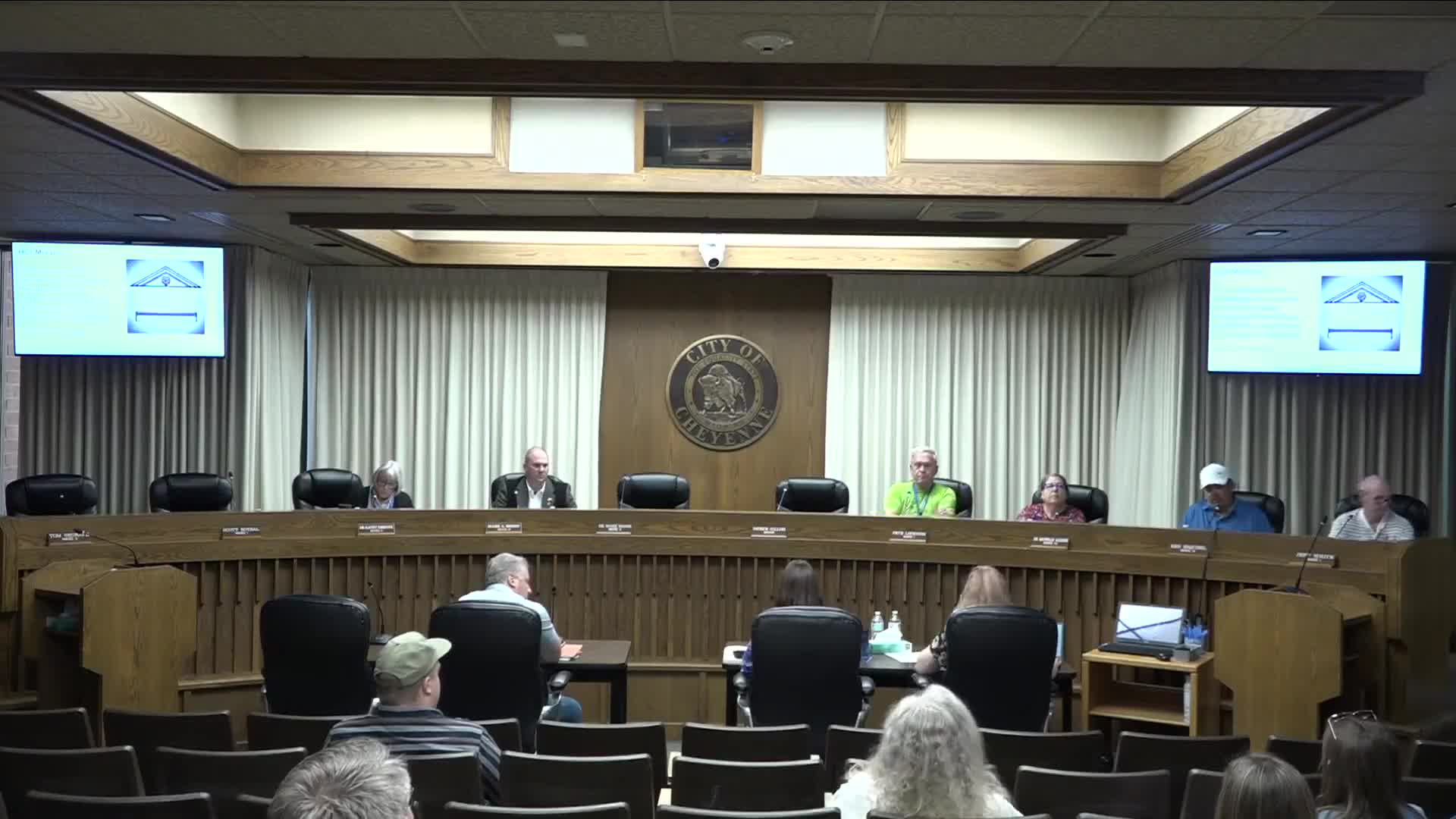
Summary
Historic Cheyenne Incorporated presented a historical overview and preliminary preservation options for the city’s late-19th-century pump house to the Cheyenne City Council and staff during a council meeting.
Historic Cheyenne Incorporated presented a historical overview and preliminary preservation options for the city’s late-19th-century pump house to the Cheyenne City Council and staff during a council meeting.
The presentation, given by Mary Kals, vice president of Historic Cheyenne Incorporated, summarized the pump house’s original engineering, social history and later municipal uses, and cited recent cost estimates and technical constraints the city must resolve before rehabilitation can proceed. "Our mission is to preserve historic properties and to educate the general public regarding the traditions, architecture, and history of Cheyenne," Kals told the council.
Kals said the pump house was built with living quarters and a large engine and boiler room to serve rapidly growing Cheyenne; she described the building’s Richardsonian Romanesque features and read press praise from the period, saying the local paper had called the structure "one of the handsomest structures in Cheyenne and will command the admiration of all who may visit that part of the city." She said the original Holly Duplex steam pump could draw up to 3,000,000 gallons per day and that an early test produced about 135 PSI at a downtown hydrant.
Why it matters: Council members framed the pump house as part of the West Edge redevelopment, the city greenway connection and the Crow Creek drainage system. Preservation advocates say saving the structure would support heritage tourism and the Fifteenth Street heritage experience; city staff and council members repeatedly raised cost, floodplain, and regulatory uncertainties that affect feasibility.
Key details and site constraints - Cost estimates: Kals reported a current planning figure from TDSI of roughly $4,000,000 for full rehabilitation and about $1,000,000 to "mothball" or stabilize the structure. Those figures include removing later additions, stabilizing trusses and roofing, and closing openings left by removed sheds. Randy Byers was identified by staff as the person who prepared the city cost estimate and could provide further detail. - National Register eligibility: Staff said research on a National Register nomination is on hold and that later, nonoriginal additions and metal sheds make the building ineligible in its current condition. Staff advised removing those additions to restore the pump-house ‘‘story’’ and to consult the State Historic Preservation Office (SHPO) on eligibility. A staff member outlined the normal process timeline: once a nomination is written, review by the SHPO and its committee can take six months to a year, and additional time may be needed for edits. - Floodplain and environmental connections: Councilmember (Dr.) Aldrich asked how the site ties to the city’s Department of Environmental Quality (DEQ) plan for Crow Creek and wetlands. City staff did not provide a conclusive answer at the meeting and said that link is important to resolve. Council members also noted the structure and surrounding parcel sit in a mapped floodplain, which could complicate insurance, development, and reuse. - Ownership and site use: City staff confirmed the city owns both the pump house and the adjacent wetlands. The pump house has been used by public works for storage and had sheds added in the 1930s; staff said those additions are the main impediment to recognizing the building as a historic resource.
Council and staff next steps discussed - Staff indicated a substituted resolution prepared by Assistant City Attorney Mr. Hopkinson will be available at a future meeting; that substitution would clarify which parcel is covered, allow leases and public-private partnerships, and authorize a market analysis rather than a simple estimate. Councilmember (Dr.) Aldrich noted that the substitution and the DEQ connection are vital to the conversation. - Staff said historic-research work on a National Register nomination can resume if the council directs it, but the nomination is on hold while the city addresses eligibility hurdles created by later additions. - The council planned an on-site tour; staff asked attendees to sign a release and advised parking and site-access precautions. Chairman Layborn invited council members to inspect the building in person.
Historical and community context Kals recounted the pump house’s original functions, early engineers who lived on-site, a reservoir once designed to hold roughly 2.5 million gallons, and later water-system upgrades (notably an 8-million-gallon Round Top reservoir and a 1916 filtration plant) that relegated the pump house to auxiliary status. She emphasized the building’s connection to the Crow Creek bottomlands, the WPA-era work near the site, and its potential role linking the greenway path to downtown.
Quotations from the record - "I did want to ask a couple of questions... how this plays into our DEQ plan for water," Councilmember Dr. Aldrich said, pressing staff on environmental planning links. - "Our mission is to preserve historic properties and to educate the general public regarding the traditions, architecture, and history of Cheyenne," Mary Kals said when introducing Historic Cheyenne Incorporated’s work. - Kals recounted a period press line she cited: the paper praised the pump house as "one of the handsomest structures in Cheyenne and will command the admiration of all who may visit that part of the city." She read the line as historical context rather than as a current city endorsement.
Outstanding uncertainties and risks Council members and staff described several unresolved items that will affect feasibility: the city’s DEQ/wetlands obligations and how they constrain reuse; floodplain limitations and insurance implications; whether the city will invest in mothballing or pursue a sale or public-private partnership; and the precise cost to remove additions and shore structural trusses. Staff emphasized that the $1,000,000 mothball figure includes structural connections of the additions and temporary infill to secure openings; the full $4,000,000 figure reflects broader rehabilitation scope.
What’s next City staff said the substituted resolution addressing leases and market analysis will be circulated for the council’s next opportunity to act, and the council scheduled an on-site inspection. Staff and Historic Cheyenne said additional research on National Register listing and detailed cost estimates will follow if the council directs further work.
Ending Historic Cheyenne framed the pump house as a public asset tied to Cheyenne’s early water system and to the West Edge redevelopment goals; council members agreed the building merits attention but identified funding, floodplain, and regulatory hurdles that must be resolved before a preservation project can proceed. The council planned a site visit and further staff work on a substituted resolution and market analysis.