District progress monitoring: training delivered but staff-of-color survey targets unmet, discipline metrics mixed
Loading...
Summary
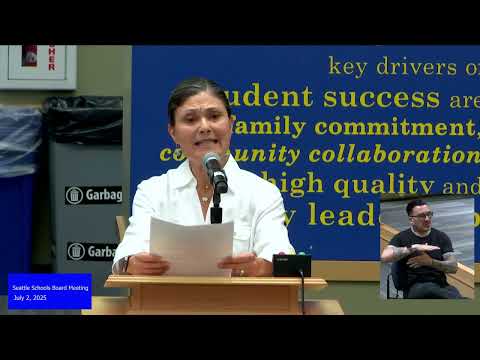
Seattle Public Schools staff reported July 2 that the district completed required anti‑bias professional development but fell short of a staff‑of‑color perception target; discipline data for students with disabilities showed long‑term improvement but a slight recent uptick, prompting additional training and clearer data coding.
District staff presented progress monitoring data July 2 on two governance “guardrails”: the anti‑racism guardrail (Guardrail 3) and discipline (Guardrail 4).
Dr. Pritchett, presenting Guardrail 3 metrics, told the board the district delivered the anti‑hate and bias procedures training in August 2023 and recorded completion by building leaders and staff: "a 100% of our building leaders and staff received that training," with about 2,400 staff earning clock hours and an average PD rating of 4.2 out of 5.
However, a second measure — the percentage of staff of color who believe their workplace is a healthy, anti‑racist environment — fell short of the target. "We did not make it to that 80%," Dr. Pritchett said, reporting the district remained roughly two percentage points below the goal for both school staff and central office staff. She characterized the metric as yellow — showing progress but still requiring work — and described ongoing supports including coaching for new teachers and principals, racial equity teams in schools, wellness programs and conflict resolution services.
Dr. Torres Morales presented Guardrail 4 on discipline and described mixed results. The district had set a goal to reduce discipline rates for students with disabilities from 9.5% to 7% by July 2024. "At the end of last school year, we were at 7.1 incidents per [100] students for students with disabilities," Dr. Torres Morales said, noting the figure met long‑term improvement targets but edged slightly above the immediate goal and has shown an uptick this year.
To address the discipline data and variation across schools, staff described steps they are taking: standardized training for school leaders in August on coding and disciplinary practices to improve data quality and consistency; expanded care‑coordination teams that bring curriculum, instruction and health staff together; and work with the Office of African American Male Achievement to share best practices in schools where interventions have worked.
Dr. Torres Morales also reported that 18 of 20 schools had incorporated mental‑health and wellness strategies into their Comprehensive School Improvement Plans (CSIPs), but cautioned that inclusion in a CSIP does not necessarily mean full implementation in classrooms. Chief accountability staff and regional executive directors are working to add monitoring and evidence expectations into leader evaluations so CSIP strategies are tracked and evaluated.
Board members asked for clearer implementation evidence, broader community input and stronger baseline data. Director Rankin described the exercise as valuable for exposing data gaps: "getting an accurate read and providing that support to principals" was necessary to identify what works for students, Rankin said.
No formal board votes were taken; staff characterized the meeting as progress monitoring and committed to continuing training, improving data collection and returning to the board with revised interim metrics and monitoring plans.