Get Full Government Meeting Transcripts, Videos, & Alerts Forever!
Get email alerts on the Project Labor Agreements topic
No spam. Unsubscribe anytime.
Dayton adopts emergency ordinance allowing project labor agreements for vertical construction over $2 million
Summary
The Dayton City Commission on July 2 approved an emergency ordinance (No. 32151-25) creating a project labor agreement policy for vertical construction projects with a $2 million threshold, while exempting Dayton Airport projects and any projects where funding rules prohibit PLAs.
The Dayton City Commission on July 2 unanimously approved emergency ordinance No. 32151-25, enacting section 35.241 of the city’s Revised Code of General Ordinances to allow project labor agreements (PLAs) on certain public construction projects. The ordinance applies to vertical construction projects with a $2,000,000 threshold, excludes Dayton Airport work, and includes an exemption when a funding source prohibits PLAs.
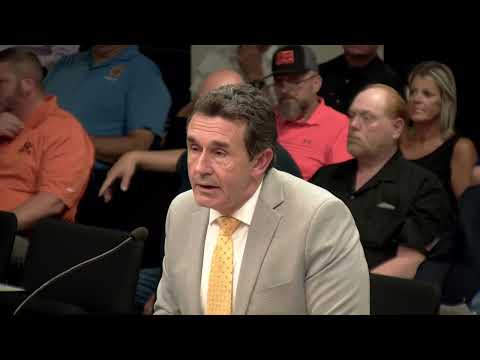
City Law Department attorney John Musto told commissioners the city drafted the ordinance to “maximize those benefits and reduce the risks.” Musto said PLAs are “a unique collective bargaining agreement that is negotiated for a specific construction project” and listed common provisions including wages and benefits, hiring procedures (often from local union halls), safety rules and apprenticeship training. He said the city chose a $2,000,000 threshold because vertical construction is typically more complex and trade-heavy, and the amount gives staff and the Human Relations Council time to educate small and minority-owned contractors before any future lowering of the threshold.
David Cox, executive secretary of the Dayton Building and Construction Trades Council, testified in favor of the ordinance, saying the council represents 16 unions and “7,000 skilled union construction workers that call Dayton and the Greater Miami Valley home.” Cox argued PLAs can increase local employment and apprenticeship use and said the policy “allows any contractor, regardless of whether they are signatory to a union, to bid on city projects.” Thomas Ritchie Sr., president of the Dayton Miami Valley AFL-CIO, urged support and praised local trades for “first quality work.”
Supporters and the law department also acknowledged risks. Musto warned PLAs, if applied improperly, can deter bidders and reduce minority business enterprise participation and could trigger federal funding complications depending on federal policy changes. He said the ordinance explicitly does not exclude nonunion contractors, includes an exemption where the funding source prohibits PLAs, and excludes Dayton Airport projects because of Federal Aviation Administration approval requirements.
Commissioners and the city manager described operational next steps included adding PLA language to applicable bid documents, coordinating outreach and education through the Human Relations Council, monitoring impacts on bidding and minority business participation, and returning with metrics for review. Commissioner Joseph noted the item reflected a long effort, saying he “realized that it’s been... a 20 year fight to get here.” Several commissioners requested a six-month and one-year review and the development of performance metrics to assess effects on cost, participation and local hiring.
Votes at a glance - Emergency Ordinance No. 32151-25 (Project Labor Agreements, enacting section 35.241): Approved (declared emergency and passed by voice/roll call vote). Roll-call votes recorded in the transcript were in the affirmative for Mayor Mims and the commissioners present; outcome: approved. - Emergency Ordinance No. 32149-25 (OWDA refinancing of sewer system Series 2015 bonds): Declared emergency and passed (first reading; immediate passage moved and seconded; voice vote). Details: authorizes city manager or designee to apply for and enter a cooperative agreement with the Ohio Water Development Authority for refinancing Series 2015 bonds. - Emergency Ordinance No. 32150-25 (OWDA refinancing of water system Series 2015 bonds): Declared emergency and passed (first reading; immediate passage moved and seconded; voice vote). Details: authorizes city manager or designee to apply for and enter a cooperative agreement with OWDA for refinancing Series 2015 bonds.
What the ordinance does and next steps The ordinance establishes a PLA policy that applies only to vertical construction projects costing $2,000,000 or more, requires PLA terms to be negotiated for each covered project, and directs staff to include PLA provisions in applicable bid packages. It excludes Dayton Airport projects because of FAA approval requirements and includes an explicit funding-source exemption to avoid blocking federal funds if federal policy changes. City staff will lead contractor outreach and education with the Human Relations Council and evaluate PLA effects on costs, bidder pools and minority business participation; the commission asked for periodic reviews and metrics to guide any future amendments.
Implementation and potential impacts Supporters said PLAs should help coordinate large projects, increase use of apprenticeship programs and keep construction wages and economic activity local. Supporters also argued PLAs can raise quality and safety standards on job sites. Critics and staff observed potential downsides: PLAs can raise costs if they reduce competition or if not structured to protect small and minority contractors; federal funding or policy changes could limit PLA use on some projects. The ordinance’s exemption for funding sources and the explicit nonexclusion of nonunion contractors are intended to limit those risks.
The commission’s adoption is the first formal step; the law department and city manager will finalize procurement language, coordinate outreach and return with monitoring metrics as the city begins to use PLAs on qualifying projects.