Get Full Government Meeting Transcripts, Videos, & Alerts Forever!
Get email alerts on the Behavioral Health Clinic topic
No spam. Unsubscribe anytime.
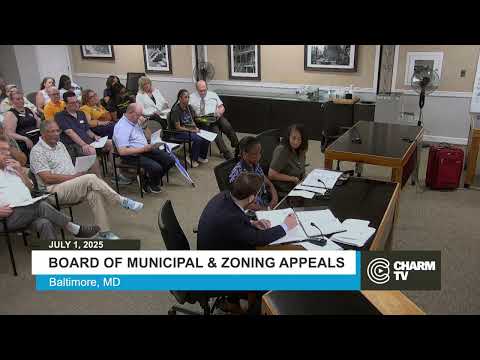
BMZA approves Bright Star Wellness clinic with conditions after contentious Pig Town hearing
Summary
A Baltimore zoning board approved a conditional-use appeal on July 1 allowing Bright Star Wellness to operate an outpatient behavioral health clinic at 772 Washington Boulevard in the Washington Village/Pig Town area, with conditions on hours, security and onsite operations.
A Baltimore zoning board approved a conditional-use appeal on July 1 allowing Bright Star Wellness to operate an outpatient behavioral health clinic at 772 Washington Boulevard in the Washington Village/Pig Town area, with conditions on hours, security and onsite operations.
The decision follows several hours of testimony from the applicant, licensing and accreditation experts, city planners and more than a dozen neighbors and business owners who said the block has already absorbed many behavioral-health providers and that more services could worsen public-safety and quality-of-life problems.
Christopher DeCarlo, the applicant’s attorney, told the board the clinic would be “low intensity” and operate 9 a.m. to 6 p.m., serving about "25 to 30 people a day." He said Bright Star is CARF-accredited for outpatient mental-health and some substance-use programming and has agreed to conditions including no on-site dispensing of medication, perimeter security cameras and limited hours. Justin Walker of the Department of Planning said the department had “no objection to the appeal” if the agreed conditions are enforced.
Supporters and the applicant emphasized licensing and accreditation steps they have completed or are pursuing. Tanya Bryce, a CARF accreditation consultant for the applicant, described the state licensing sequence and oversight: “We do not administer nor do we, hold medication,” she told the board, adding that preliminary accreditation and a one-year state license process are standard before full licensure. Bryce also described a “good neighbors” policy that requires clients to review rules and that violations can lead to administrative discharge.
Opponents — including nearby residents, small-business owners, and Pig Town Main Street representatives — said the corridor already houses multiple treatment providers and pleaded that another clinic would strain street-level safety and business recovery efforts. Several speakers cited visible drug use, discarded syringes, loitering and theft in the neighborhood and asked the board to deny the appeal or require a firmer plan for community engagement and follow-up.
The board’s discussion centered on whether the clinic would create adverse impacts “above and beyond” those normally associated with a health-clinic conditional use in a C-1 commercial district. Several members noted the site is within the Washington Village urban renewal plan and that the proposed use is a permitted conditional use in a C-1 zone. Members who supported approval cited the applicant’s limits on hours and client volume, the CARF accreditation and letters of support from the Baltimore City State’s Attorney’s Office and the Maryland Commission on Civil Rights, which were entered into the record.
Board members who voted for approval said conditions suggested by the planning department and the applicant — including restricted hours (9 a.m.–6 p.m.), no on-site dispensing of controlled substances, perimeter cameras and a required community-feedback mechanism — would reduce the risk of adverse impacts to the level expected for the use in that zoning district. Several board members urged sustained, active engagement between the operator and neighborhood organizations after the meeting.
The board did not adopt a motion to require a specific enforcement mechanism beyond the normal administrative and licensing checks; staff and community speakers noted state oversight (Behavioral Health Administration and CARF reviews) and local reporting channels would remain available. The board’s approval is subject to the usual written resolution to be drafted following the hearing.
The applicant and supporters said they will continue community outreach and that CARF and the state licensing process provide recurring compliance checks; opponents said they will monitor whether the clinic’s presence changes street-level conditions.
The board’s written resolution — which will list final conditions and any follow-up responsibilities — is required by statute and will be issued in the coming weeks and posted to the city’s appeals portal.
Bright Star Wellness and its consultant said they would proceed to complete state licensing steps after local authorization and continue community engagement.
Ending: The written resolution required to finalize the board’s approval will be drafted and issued in the weeks after the hearing; the applicant must complete state licensing and accreditation steps before offering the full scope of care described in testimony.