Get Full Government Meeting Transcripts, Videos, & Alerts Forever!
Get email alerts on the College Access topic
No spam. Unsubscribe anytime.
PHEAA access partners urge students to use summer for college planning, FAFSA prep
Summary
Pennsylvania Higher Education Assistance Agency access partners Tiffany DeVan and Sonia Mann McFarling advised students during a PHEAA webinar to use summer months for campus visits, career exploration, test preparation and scholarship searches, and reminded families that the FAFSA opens Oct. 1 and PHEAA’s statewide webinar series begins July 10.
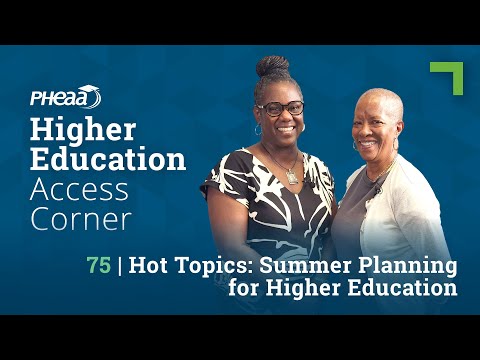
Tiffany DeVan, a higher education access partner with the Pennsylvania Higher Education Assistance Agency (PHEAA), and Sonia Mann McFarling, a PHEAA access partner for Lancaster, Lebanon, Berks and Chester counties, urged prospective college students during a PHEAA “Higher Education Access Corner” webinar to use summer months to prepare for college admissions and financial aid.
The partners outlined a short, actionable planning list: visit campuses (in person or via enhanced virtual tours), explore careers and matching schools using educationplanner.org, prepare for standardized tests (SAT/ACT), build scholarship résumés and essays, and gather transcripts and recommendation letters in advance. They also pointed listeners to PHEAA’s webinar series (pheaa.org/virtual) beginning July 10 and reminded families that the Free Application for Federal Student Aid (FAFSA) opens Oct. 1.
“Get on the college campuses that you hope to apply to,” DeVan said, adding that campus visits help students choose a school that “feels good” rather than following others’ recommendations. McFarling recommended career exploration first: “If you’re going to major in something, what does the job market look like?” She pointed attendees to educationplanner.org for career assessments, lists of training programs and salary information.
Both access partners recommended that students combine career research with realistic financial planning. McFarling advised a conservative borrowing strategy: “Do not borrow more than you expect your first‑year salary,” she said, explaining that comparing expected earnings with likely loan payments helps preserve post‑graduation quality of life. They also recommended PHEAA’s My Smart Borrowing resources for students considering loans.
On test prep, the speakers noted that educationplanner.org provides practice SAT and ACT exams, while official SAT registration and scheduling are available at collegeboard.org. DeVan urged students to check College Board’s BigFuture program early: it offers scholarship leads and incentives tied to activities such as researching colleges and completing milestones. Both emphasized fee waivers and counselor help for students who cannot afford test fees.
For scholarship strategy, the partners advised prioritizing local awards—scholarships offered by a student’s high school, employer or community organizations—because those carry less competition, while also applying for national awards. They encouraged students to draft a standard personal essay over the summer that can be tailored to different scholarship applications.
Practical application steps included preparing transcripts, knowing reference providers’ schedules, and completing admission and financial aid forms early. DeVan recommended having admission applications submitted “preferably before you leave for the Thanksgiving break,” so schools can review first‑round materials. McFarling noted that some institutions will reopen admission review in the fall and that institutional aid may require additional forms such as the CSS Profile.
Both presenters repeated that PHEAA’s services are free and invited listeners to contact their local access partners for virtual sessions. DeVan provided the webinar sign‑up page at pheaa.org/virtual and encouraged families to register for sessions on PA state grant application steps, FAFSA completion, and scholarship searches.
The webinar wrapped with a reminder to balance planning with rest: the partners suggested students use the summer to prepare but also to recharge before the academic year.