
Commission delays vote on ordinance setting minimum distances for gas stations near homes, schools and day‑care centers
Get AI-powered insights, summaries, and transcripts
Subscribe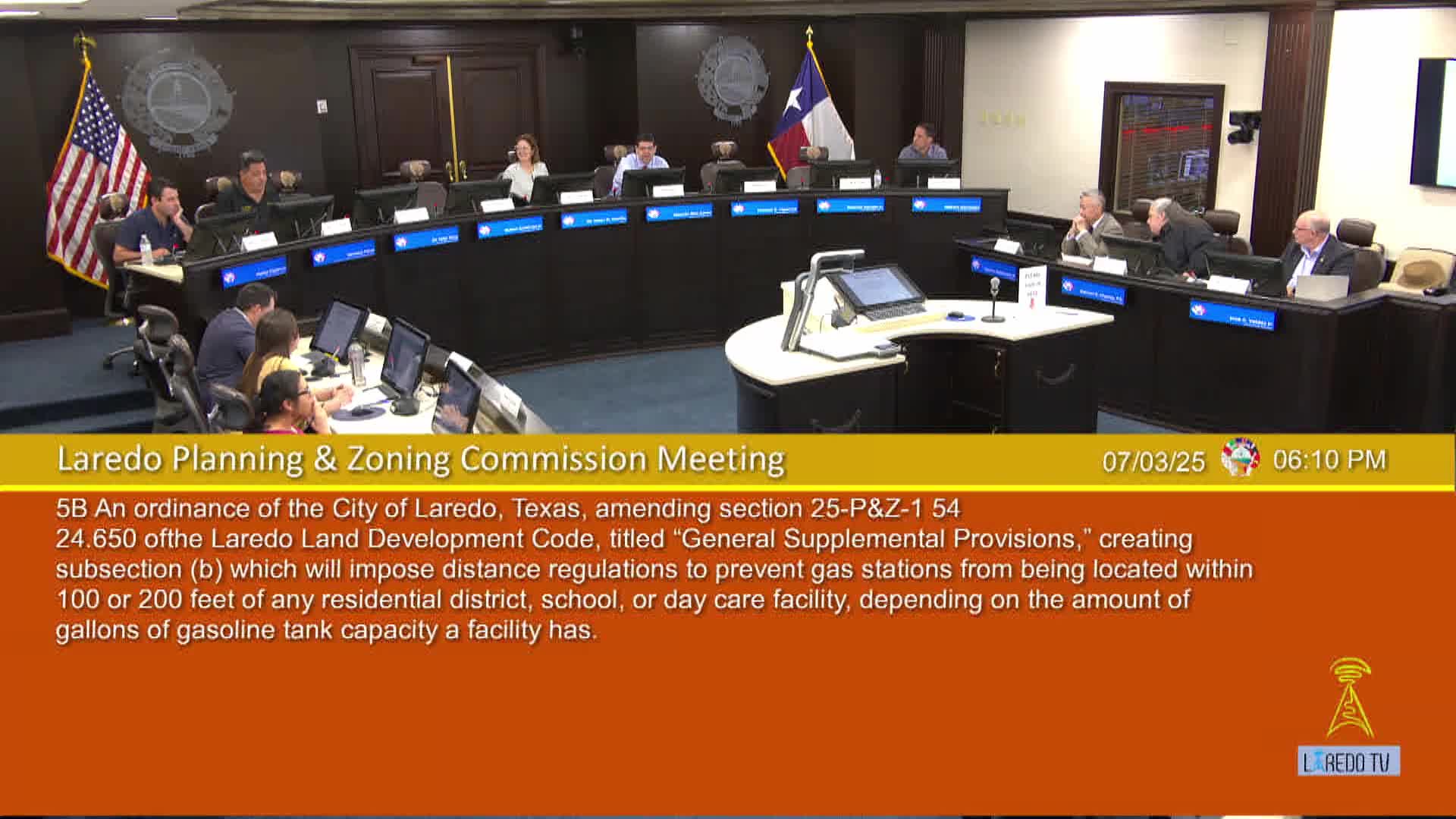
Summary
The commission heard detailed debate about a proposed amendment to Section 24.65 of the Laredo Development Code that would impose 100‑foot or 200‑foot buffers for gas stations depending on tank capacity; commissioners voted to table the item to obtain more information about definitions, fuel types, zoning conflicts and nonconforming uses.
The City of Laredo Planning Commission voted to table consideration of an ordinance that would add distance requirements to Section 24.65 of the Laredo Development Code, intended to prevent gas stations from being located within specified distances of residential districts, schools or day‑care facilities.
Legal staff described the draft ordinance as originating with Councilmember Dr. Tyler King, and said it would impose a 100‑foot buffer if a facility’s tank capacity is less than 50,000 gallons and a 200‑foot buffer for facilities with 50,000 gallons or more, “to protect children, day care centers, and residences.” The staff member also said there is no current citywide ordinance on the topic.
Speakers raised questions about the draft’s definitions and practical effects. Orlando Navarro, a landowner and developer, said “there’s just information missing. We don't have a presentation. We don't have history,” and asked whether the rule would treat multiple smaller tanks as a single capacity or evaluate installed capacity. He also noted existing zone standards that in some cases already require 300 feet from residential districts and warned the proposed distances could create conflicts with planned residential developments.
Commissioners and staff discussed whether the rule would cover gasoline, diesel and kerosene; the transcript records questions about whether diesel should be treated the same as gasoline and a statement that verification was needed. Legal staff said existing gas stations that would fall within the new distances would become legal nonconforming uses and that the ordinance is not retroactive to require removal; however speakers noted a practical effect that if a nonconforming station closed and later sought to re‑open in the same location it could trigger the new standards and be prevented from reopening.
Traffic and zoning interactions were a persistent concern: commissioners asked whether the proposed distance standards conflict with existing zoning rules (for example, B4 zones that already require a 300‑foot separation from residential). Commissioners asked for clearer definitions of “gas station,” “fuel capacity,” and whether capacity means single tank size or total installed capacity across tanks.
After extended discussion, a commissioner moved to table the ordinance to collect more information; the motion was seconded and passed. The transcript records speaker concerns about missing data and a recommendation from several commissioners to reconvene with additional analysis and stakeholder input before acting.
Unresolved items recorded in the meeting: whether capacity refers to tank design capacity or operational fill level; whether diesel, kerosene and other fuel types are included; a crosswalk between the proposed distances and existing zoning restrictions; and a more complete inventory of existing gas stations that would become legal nonconforming uses under the draft code.