Get Full Government Meeting Transcripts, Videos, & Alerts Forever!
Get email alerts on the Tax Increment Finance Tif topic
No spam. Unsubscribe anytime.
Marathon County committee forwards resolution to tighten guidance for TIF joint review board representative
Summary
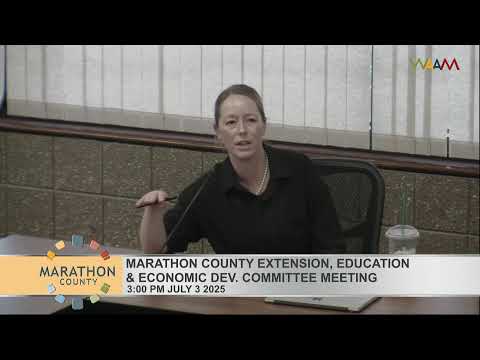
Marathon County’s Extension Education and Economic Development Committee voted Thursday to forward a resolution to the full County Board instructing the county’s representative on tax incremental district joint review boards to oppose TIDs whose financial projections “do not recover the projected debt and TID investment in the proposed life of the district.”
Marathon County’s Extension Education and Economic Development Committee voted Thursday to forward a resolution to the full County Board instructing the county’s representative on tax incremental district joint review boards to oppose TIDs whose financial projections “do not recover the projected debt and TID investment in the proposed life of the district.”
The resolution, moved by Vice Chair Feiffrich and seconded by Supervisor Hagen, passed in committee but not unanimously; the transcript does not record a roll-call vote or individual tallies.
Supporters said the guidance is meant to give the county’s designee clearer standards when reviewing proposed TIDs. “We’re establishing criteria for our joint review board representative to work off,” Vice Chair Feiffrich said during committee discussion, adding that the resolution relies on questions and considerations found in the TIF manual rather than imposing strict new statutory limits.
Public commenters urged stronger limits and clearer county policy. Pete Weinshank, of Edgar, told the committee that Wausau’s Tax Incremental District No. 12, created in 2017, would not return net benefits to a typical homeowner within the commenter’s estimated lifetime: “My analysis says that the owner of an average price house in Marathon County will get property tax relief equal to the extra taxes paid to support TID number 12 in 2074,” Weinshank said.
Local officials warned against overreach. Dave Baker, identified as village president of a local village, said a proposed subdivision of about 110 homes — which he estimated would add roughly $35,000,000 in new construction — would likely be infeasible without TIF assistance to extend utilities. “I cannot justify spending personal or village resources on a potential new TIF district with the current level of county-generated uncertainty and risk,” Baker said.
County staff described the operational implications of adding review criteria. Administrator Leonard said the county’s designee, who attends JRB meetings, already reviews many districts and that extra or more-complex financial analysis would add staff time: “Let's assume it's two hours to review, one hour to attend, each of those. That's three hours for each one of the 40 [active] districts. That's 120 hours a year,” Leonard said, noting that heavier analysis would affect other staff duties.
Committee members debated whether to set a maximum TID life in the resolution. Some supervisors urged reliance on existing Wisconsin statutes and the Department of Revenue guidance rather than a county-defined cap; others expressed concern about “donor” districts that shift increment from successful districts to underperforming ones. Supervisor Rosenberg asked how the resolution would prevent poorly performing districts from being propped up by donor districts; Vice Chair Feiffrich pointed to the resolution’s front-end criteria for project plans and development agreements as the primary check.
The resolution as forwarded instructs the county’s representative to vote to set termination dates consistent with state law and to withhold support for any TID whose financial projections do not recover projected debt within the district’s proposed life. The committee discussion noted that state law contains different statutory maximums for certain classes of districts and that the Department of Revenue’s TIF manual provides nonbinding “questions to consider.”
The committee voted to forward the resolution to the County Board for final action. Because a roll-call was not recorded in the committee transcript, the committee-level vote is noted as “passed” and “not unanimous” but no individual vote record is provided.