Get Full Government Meeting Transcripts, Videos, & Alerts Forever!
Get email alerts on the Wastewater Treatment topic
No spam. Unsubscribe anytime.
North Brookfield to apply for SRF loan as wastewater clarifiers near end of service
Summary
Town officials voted to authorize staff to apply for a State Revolving Fund loan after the sewer superintendent warned both secondary clarifiers at the wastewater treatment plant are in poor condition and replacement parts are obsolete.
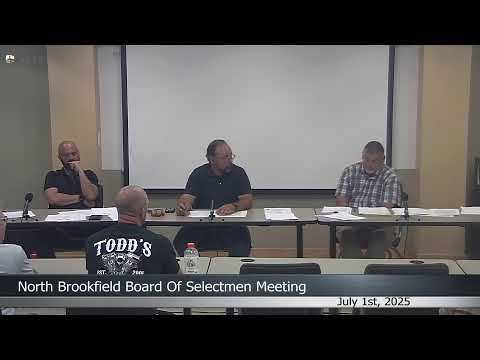
The North Brookfield Board of Selectmen voted to authorize an application for a State Revolving Fund (SRF) loan after the town's sewer superintendent described both secondary clarifiers at the wastewater treatment plant as aging and increasingly at risk of failure.
The move begins a formal SRF loan application process that does not obligate the town to accept financing but would preserve the option while the town pursues a separate grant application through a U.S. senator's office.
Eric Cardenas, the town's sewer superintendent, told the board that the clarifiers — deep settling tanks roughly 15 feet deep that remove solids and allow biologically treated water to clear — are “an essential piece to the treatment plant. Without those clarifiers, you do not have treatment.” He said the clarifiers are in “pretty rough shape,” that some mechanical parts are obsolete and that replacement lead times for new equipment could be eight months or longer, with overall repairs and installation potentially taking more than a year.
Cardenas said the sewer department recently advanced a grant request through the state senator's office (he described the requested amount as about $2.5 million) and that the senator's office approved the request in its first review. That request must still pass further federal review, he said.
As a backup, Cardenas outlined the SRF loan process administered through the Massachusetts Department of Environmental Protection (DEP). He said SRF loans are typically offered at about 2 percent interest and usually set up over 20 years (30 years sometimes possible). Using preliminary estimates he presented, a 20-year loan at 2 percent would cost the sewer department roughly $91,000 annually; dividing that estimate by the town's sewer customers produced a rough per-user estimate near $100 per year. Cardenas said that if the town were able to cover half the debt with septic-system revenues, the per-customer share would fall to about $49 annually. He emphasized those were illustrative figures for budgeting, not final rates.
Board members asked how imminent a full failure might be; Cardenas said it was hard to predict, that the tanks could last several more years but that failure of components (scrapers, gearboxes, a leaking planetary gearbox) was possible and would create long compliance and operational problems. He warned that a clarifier failure could lead to prolonged noncompliance with the plant's permit and lengthy, costly emergency repairs.
After discussion, Selectman Jamie Goeman moved to approve pursuing the SRF loan application; the motion was seconded and the board voted in favor. The board did not commit to taking loan funds if offered. The SRF application deadline the superintendent cited is July 25; Cardenas said the application is extensive and requires supporting documentation and engineering packages.
The board also asked staff to confirm that pursuing the SRF loan would not imperil the senator-office grant application and directed engineers to continue preparing the supporting documents. Cardenas said the engineering design for clarifier replacement work already exists and had been included as a bid alternate in the larger plant upgrade, but contingency limits and other change orders left insufficient funds to complete the clarifier work as part of the original project.
The board's vote preserves the town's financing options while the grant review continues and while engineers finalize cost and schedule details.