
Palm Coast council adopts higher transportation impact fees citing "extraordinary circumstances"
Get AI-powered insights, summaries, and transcripts
Subscribe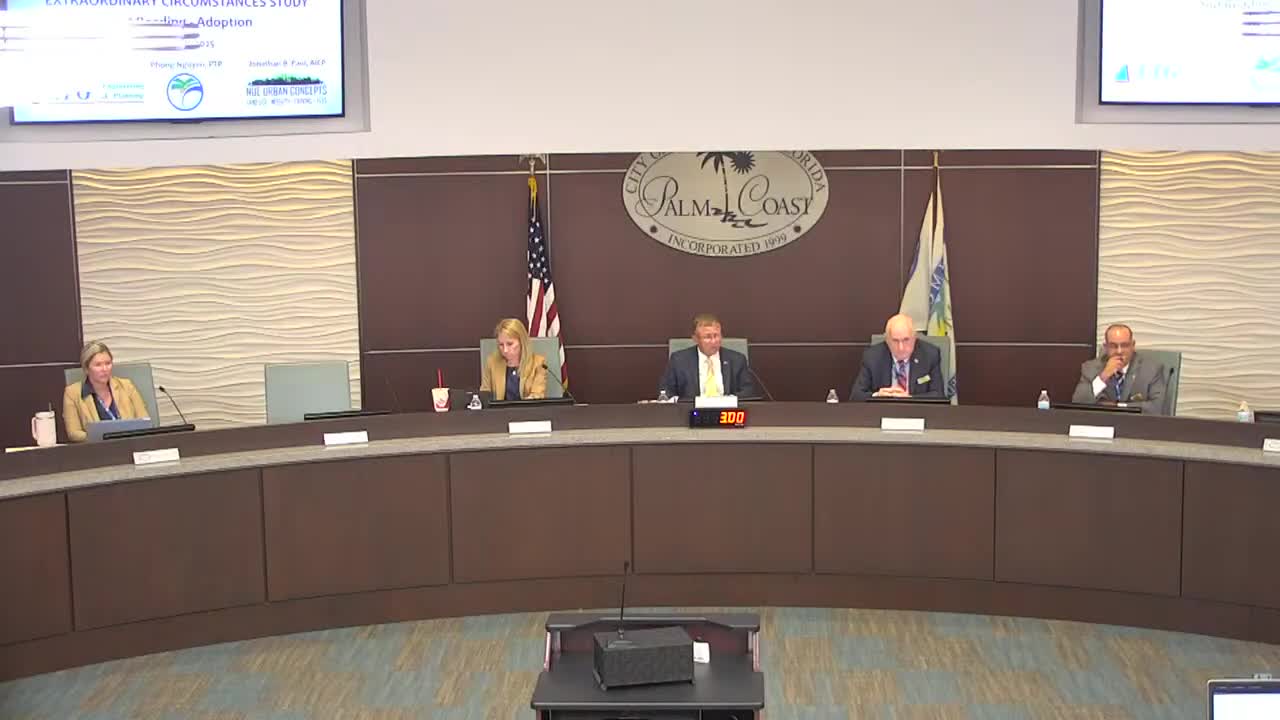
Summary
The City Council voted unanimously to adopt updated transportation impact fees after a study and extraordinary-circumstances findings; builders and housing advocates warned the increases will raise housing costs.
Palm Coast — The City of Palm Coast City Council voted unanimously on July 1 to adopt updated transportation impact fees after receiving a comprehensive technical report and an "extraordinary circumstances" study, moving the city to collect the new rates beginning this fall.
City planning staff said the fee changes respond to local growth and sharply higher construction and right-of-way costs. The ordinance, which amends Chapter 29 (Impact Fees) of the Palm Coast Code of Ordinances, implements rates based on the June 2025 Transportation Impact Fee Technical Report and an extraordinary-circumstances analysis prepared by LTG and New Urban Concepts LLC.
The increases were opposed by representatives of the local building community and affordable-housing advocates who urged the council to limit increases to the 50% cap expressly allowed under state law. "We support a legal, justified increase up to the 50% cap allowed under Florida's law," said Anna Maria Long, executive officer of the Flagler Home Builders Association, at public comment. Long argued that statewide construction cost trends do not meet the statute's standard for extraordinary circumstances and warned the move would push housing prices higher.
Planning staff outlined the factors used to justify the extraordinary-circumstances findings: higher-than-state growth rates locally, projected higher population growth, and substantial inflation in the cost of right-of-way and intersection improvements. Fong Wing, senior planner with the Community Development Department, told the council the technical report uses the most recent localized data and a $30 million reasonably anticipated funding assumption to offset fee calculations.
Council members discussed the appeals process before the vote. Vice Mayor Kay Pontieri asked that any appeal authority be clearly placed with City Council rather than the city manager; staff confirmed the ordinance language would be revised so appeals come to council.
The council approved the ordinance by motion; the ordinance's collection of the new fees is tied to the ordinance's effective date provisions. Staff said the ordinance provides a 90-day statute-based period before collection begins; the first day for collecting new fees was described in the ordinance as October 1, with the 90-day notice placing the actionable date around early September.
Supporters of the fee increases argued fees must reflect current costs so new development pays its share of improvements. "Limiting increases in fees will impact the ability of the city to fund improvements to ensure new development mitigates its transportation impacts," the staff presentation warned.
Opponents said the extraordinary-circumstances claim was a legal stretch. At the meeting, several members of the public urged the council to preserve housing affordability, while others — including longtime local developers and residents — said the city has undercharged developers in prior years and that shifting costs onto new development is fair.
Outcome: City Council approved the ordinance amending Chapter 29 to adopt updated transportation impact fees and accepted the accompanying extraordinary-circumstances study. The vote was unanimous. The ordinance states new fee collection will begin in October 2025 (90 days after statutory notice); staff confirmed the ordinance text and appeals language would be clarified following council direction.
Background: The transportation impact fee update was presented at first reading on June 17, 2025; the June technical report and the extraordinary-circumstances findings were the principal bases for the second-reading action on July 1.