
La Mesa council directs staff to study temporary neighborhood speed-hump pilot after residents press for faster relief
Get AI-powered insights, summaries, and transcripts
Subscribe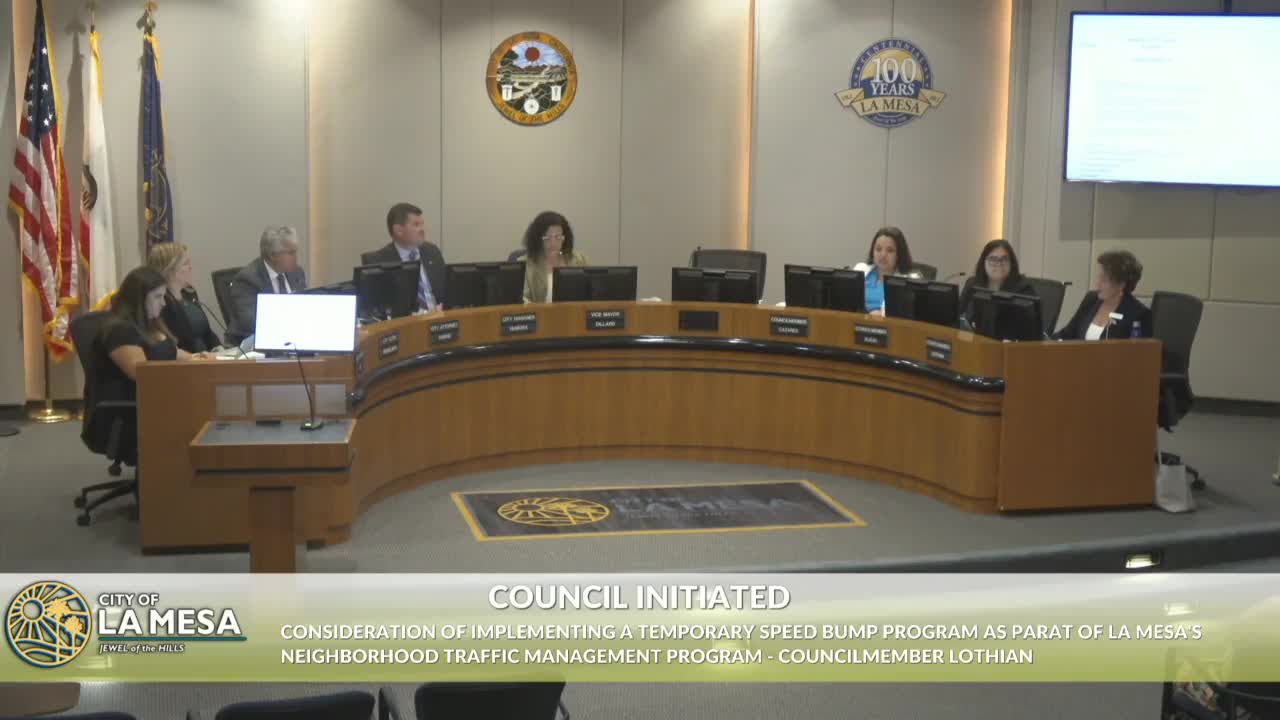
Summary
Councilmember Lothian's proposal to explore a temporary speed-hump program for small residential streets passed unanimously. Supporters at the hearing said temporary rubber humps provide an affordable, reversible traffic-calming tool for short blocks; staff will study feasibility, legality and logistics.
The La Mesa City Council voted unanimously to direct staff to study the feasibility, legality and logistics of a temporary speed-hump program intended for small residential streets.
Councilmember Lothian, who brought the item forward, told the council that the existing neighborhood traffic management program can take years and carries a high bar for permanent traffic-calming measures. She said temporary, bolt-down speed humps would be an affordable, reversible way for neighborhoods to test whether calming measures work before investing in permanent asphalt humps that can cost about $20,000 each.
"This is something very cost effective, very easy to install, and also effective," Lothian said during the presentation, demonstrating rubber speed-hump units and citing examples of retail prices and load ratings. She noted the devices bolt to pavement, can be removed if a neighborhood decides it does not want them and are better suited for small residential streets rather than busy thoroughfares.
Several residents and commissioners spoke in support. Barbie Wheeler, a Bellflower Drive resident, said her block collected signatures and that neighbors want the temporary measure to slow speeding vehicles, in particular late-night drivers. "I'm here to be a cheerleader because I am supporting this initiative," Wheeler said, urging the council to include Bellflower Drive in the program.
Jerry Jones, chair of the Planning Commission (speaking for himself), told the council he was not initially a fan of speed bumps but said the traffic-calming program has a high threshold and long delays. He recommended the council consider a broader, low‑stakes set of temporary measures (humps, bollards and similar options) and suggested either a subcommittee or a staff report that examines the program holistically.
Council members clarified that the program would target small neighborhood streets and not major thoroughfares such as University Avenue or El Cajon Boulevard. The city attorney and council discussed motion language; the adopted motion directs staff to study feasibility, legality, logistics and other considerations associated with implementing a temporary speed-hump (hump/hump-style device) program.
Councilmember Lothian described examples during her presentation: permanent asphalt speed humps at roughly $20,000 each and low-cost rubber/portable units that she said are sold in consumer and industrial grades (she cited examples priced around $80 for a two-piece consumer unit and higher-duty units around $269). She also referenced a block example — Bellflower Drive — that is roughly 500 feet with about 17 houses, where residents said they had gathered signatures supporting temporary humps.
The council voted "motion carries with all council members voting yes." Staff will return with a report laying out legal, logistical, cost, maintenance and resident-notice considerations and a recommended approach for pilot installations.
Background: the city’s Neighborhood Traffic Management Program (NTMP) sets standard criteria and traffic‑study thresholds for permanent measures; proponents argued a temporary program could provide quicker, lower-cost relief and data to inform permanent decisions.
Next steps: staff to prepare a report on feasibility, including streets that do not meet NTMP thresholds, cost estimates, resident-consent procedures and removal/maintenance plans. The council suggested any pilot exclude major thoroughfares and prioritize residential blocks that request temporary mitigation.