Get Full Government Meeting Transcripts, Videos, & Alerts Forever!
Get email alerts on the Arts Grants Funding topic
No spam. Unsubscribe anytime.
Committee reviews Metro Arts grant criteria as artists, council members press for changes and records fixes
Summary
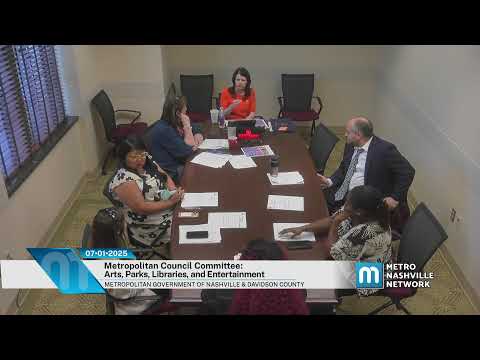
The Arts, Parks, Libraries & Entertainment Committee met July 1 in Committee Room 4 in Nashville to review Metro Arts' proposed grant criteria for the upcoming grant cycle and to hear public comment and committee concerns about equity, fiscal-sponsorship rules and missing application records.
The Arts, Parks, Libraries & Entertainment Committee met July 1 in Committee Room 4 in Nashville to review Metro Arts' proposed grant criteria for the upcoming grant cycle and to hear public comment and committee concerns about equity, fiscal-sponsorship rules and missing application records.
Metro Arts interim executive director Ashley Batchelder told the committee the presentation at the July 15 meeting will propose criteria that keep a fiscal-sponsorship requirement for applicants who are not 501(c)(3) organizations, set the Thrive (project) maximum award at $15,000 and establish a $750 flat administrative fee for fiscal sponsors that is paid on top of the awarded budget. "We need to approve our applications, collect applications, and then score them and award in September," Batchelder said, adding that the department plans to launch applications on July 16 and aims to have funds distributed by the end of the calendar year.
Why this matters: the Metro Arts grant programs distribute city funds across individual artists and arts organizations; changes to award sizes, administrative fees and sponsor rules affect who can apply, how much money individual artists receive and how quickly grants are paid. Batchelder said the current funding split for the last cycle allocated $1,300,000 to Thrive and $1,900,000 to operating grants (about a 40% allocation to Thrive), and that allocation and final award sizes will be decided after applications are received and scored in September.
Discussion and dissent: Councilwoman Stiles said she will vote no on the resolution when it comes to the committee July 15, saying the process “regressed” since the prior director and that the department has not fully addressed last year’s problems. "I will be a no with the legislation that comes before us," Stiles said, adding that while she praised Batchelder's efforts, she believed the committee had "missed the mark" on criteria and equity.
Public comment: Christine Hall, who identified herself as a long-time District 17 resident and artist, urged the committee to prioritize direct funding to individual artists and smaller organizations and said the Thrive program should aim to return tax dollars to the communities most directly. "Art is life," Hall said. She called for at least half of grant dollars to go to individual artists and smaller organizations and said reducing Thrive awards from $20,000 to $15,000 "is not a good move."
Applicant experience and records issue: Ingrid Brown, president of the International Black Film Festival, described difficulties accessing her organization’s application records in Submittable from January 2024. Brown said the application she submitted in January 2024 did not appear in her account after a system re-opening last year, that she lacked the opportunity to choose between Thrive and operating as instructed by new guidelines, and that Submittable restored a different version rather than the original entry. Batchelder confirmed Metro Arts saw records in its administrative account and that staff had processed the applicant’s payment the prior week; Batchelder said there are customer-service channels with Submittable and that she could export application records for applicants who cannot access them.
Policy and legal context: Committee members discussed whether state law or other statutory language prevents Metro Arts from paying individuals directly and noted Metro Council's legal office provided guidance indicating a statutory change could be required to allow direct payments without fiscal sponsorship. The chair said she would work with council counsel to draft a supporting resolution to ask the Davidson County state delegation to consider changes that could permit direct artist payments.
Process, timeline and next steps: Batchelder described the immediate steps as (1) committee consideration of the criteria resolution on July 15, (2) an application launch on July 16 with a one-month window, (3) application scoring and allocation decisions in September, and (4) anticipated disbursements toward the end of the calendar year (subject to central finance processing). She emphasized the department is behind schedule compared with a normal cycle and that this cycle's timing is intended to avoid repeating last year's delays.
Decisions taken at the July 1 meeting were limited to two consent items related to Parks and Library partnerships and an in-kind grant; both consent resolutions were approved unanimously 7-0. No formal committee vote on Metro Arts' criteria or allocations was taken on July 1; the resolution will be formally presented July 15.
Ending note: Committee members and Metro Arts staff said they would continue outreach, one-on-one applicant support and try to address Submittable access and record concerns before the next committee meeting. Council members reiterated interest in pursuing a statutory remedy if necessary to enable direct payments to individual artists.