Get Full Government Meeting Transcripts, Videos, & Alerts Forever!
Get email alerts on the Economic Development topic
No spam. Unsubscribe anytime.
Consultant presents final comprehensive economic development strategy; commission recommends adoption to council
Summary
A consultant told the City of College Place Council on July 1 that the city’s final comprehensive economic development strategy (SEDS) meets Federal Economic Development Administration requirements, outlines five strategic areas and performance metrics, and will be transmitted to the council for approval after the public comment period closes.
Consultants presented the final version of College Place’s comprehensive economic development strategy (SEDS) to the City Council workshop on July 1, describing the plan’s development process, five strategic focus areas, evaluation metrics and next steps for EDA review.
"The SEDS, as we refer to it, is short for comprehensive economic development strategy, and it's a process that is managed by the Federal Economic Development Administration," said Mr. Saldanha, consultant, who led the presentation. He said the document "fulfills all of those requirements." (Mr. Saldanha, consultant.)
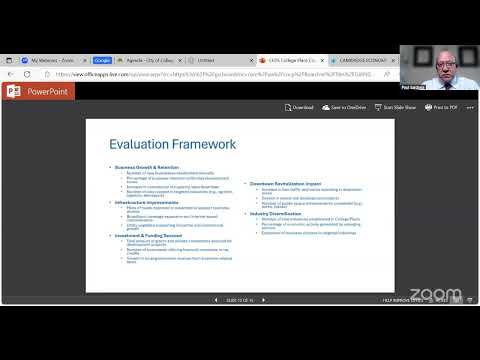
The document is a collaborative product by Economic Growth Strategies and partner firms, including Strat Herrera, the NATO Sundale Group and the International Sustainable Resilience Center. The presenters said the public draft was published June 2, that the draft plan summarizes a roughly 60-page economic conditions report, and that the plan includes an evaluation framework and an implementation action list.
Why this matters: the SEDS is a prerequisite for many EDA-funded projects and lists projects and project categories that the city could pursue for federal grant support, including transportation, broadband, utilities, downtown revitalization and tourism-related amenities.
Key points presented by the consultant:
- Process and eligibility: The plan includes stakeholder interviews, a competitive analysis and a 30-day public review. The consultant said staff and the EDTC commission were used as the working group and that the draft aligns with the city’s current economic development element and the state's Growth Management Act.
- Strategic focus areas: The plan organizes action items under five categories: attracting diverse businesses (marketing, incentives, development opportunity areas); downtown revitalization (streetscapes, façade improvements, events and a downtown master plan); collaboration with local institutions (internships, shared facilities, workforce training); infrastructure and connectivity (transportation, utilities, broadband); and tourism (promoting attractions, events, hospitality expansion).
- Project specificity and metrics: The consultant said the plan lists specific projects and includes performance measures such as numbers of new businesses, miles of road improved, increases in broadband coverage and downtown spending to track progress over the strategy’s five-year horizon.
- Public engagement and edits: The presenter said the EDTC commission requested striking one draft weakness that characterized a local perception as "primarily a Seventh-day Adventist community." The commission recommended removing that item from the SWOT analysis; the consultant said the change will be made in the final version.
The EDTC commission recommended adoption of the plan to the council, the presenter said. "We will be transmitting to the clerk the final final plan for, for your, for your approval at a future meeting," Mr. Saldanha said. (Mr. Saldanha, consultant.) The public comment period was noted as closing July 2; the consultant said the next step is formal council approval and then submission to the Economic Development Administration for its review and grant-closeout processes.
Council members had no substantive edits at the workshop; Council Member Boyle thanked the team and Council Member Jessup and Cleveland had no questions. Interim City Administrator Michael Mathias asked about macroeconomic risk factors such as interest rates and inflation; the presenter said the strategy is built on local economic fundamentals and is intended to be resilient over the plan’s five-year horizon.
The presentation also referenced the recent Martin Airfield planning study as material the consultants incorporated into land-use recommendations. The consultant said they will continue to coordinate with the city’s comprehensive plan update.
The council did not vote on the plan at the workshop. The consultant and staff will finalize the plan after the public comment period and bring it back to the council for formal approval and then transmit it to EDA for their review.