
Putnam County schools warn of budget risks after state report, property valuation gap and bond-driven tax increase
Get AI-powered insights, summaries, and transcripts
Subscribe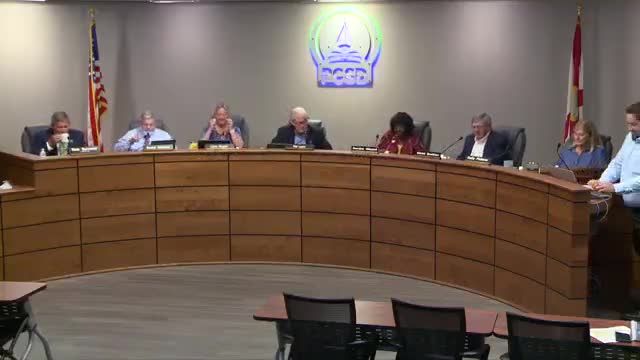
Summary
Jonathan, finance staff for the Putnam County School District, told the board the preliminary budget shows modest state increases but flagged a roughly $733.6 million gap between the legislature’s conference-report property valuation and the county appraiser’s roll that could cut local revenue and state allocations.
Jonathan, finance staff for the Putnam County School District, told the school board during a budget workshop that preliminary figures from the legislature’s conference report would add limited, earmarked revenue but that a mismatch between the conference report and the property appraiser’s certified values could produce a substantial revenue shortfall.
Why it matters: the district’s preliminary calculations show the conference report adds new categorical and salary dollars but that a roughly $733,599,082 difference between the conference report value (about $9.12 billion) and the property appraiser’s roll (about $8.39 billion) could reduce local tax revenue and lower some state allocations, Jonathan said. He cautioned the numbers can still change when tax rolls and the FEFP are finalized in July.
The conference report increases shown to the board include categorical allocations and teacher salary money already earmarked in state funding: a mental-health categorical at $694,809, Safe Schools at $1,180,148 and a teacher salary allocation (TSIA) totaling $4,371,530 (an increase of $389,380). Jonathan said the district’s preliminary “new money” that is not already earmarked was about $713,215 but that increases in district costs — especially retirement rate changes — would reduce that to roughly $513,000 in net new, flexible funds.
“This increase translate[s] to a $224,987.12 increase in retirement for our regular class employees,” Jonathan said, referencing a rise in the regular-class retirement rate to 14.03 percent. He also noted other retirement-rate decreases that partially offset the total impact.
Enrollment and FEFP mechanics: the workshop reviewed projected FTE totals in the conference report — 10,421.14 students for 2025–26, an increase of about 211 students over the current year. Jonathan said a later “fourth calc” could change that projection by roughly 50 students, which would affect funding. He also emphasized that the conference-report student count still includes students who leave district schools for charter schools and scholarship programs (FES), and that FES scholarship growth has driven significant budget pressure in recent years.
Property tax collection and valuation risk: the finance presentation showed the district has collected 95.62 percent of the current-year property tax roll so far, below the 96 percent the district budgets as a conservative baseline. Jonathan said a missing tax-certificate-sale payment (commonly received late in the fiscal year) typically fills that gap; without it, the district could face a shortfall of roughly $1,362,977 compared with prior years.
More materially, the presentation compared the state’s conference-report property valuation ($9,119,176,480) with the county property appraiser’s valuation ($8,385,577,398) and reported a $733,599,082 difference. Jonathan told the board, “If it comes in at the 8.3 billion number or anything other than the 9.1 billion, then we’re gonna lose money in both categories,” meaning local revenue and some state adjustments tied to millage and FEFP mechanics could both fall.
Millage and bond impact: the district will levy additional debt millage tied to recent bond issuances. Jonathan showed debt millage rising from 0.849 mills to 1.716 mills because of an additional $100 million in bonds; combined with other components this would raise the total district millage to about 6.986 mills, an increase of 0.856 mills. Using the district’s example math, that change results in about $171.60 per $100,000 of taxable value (after homestead exemption); Jonathan framed the rate equivalently as roughly 47 cents per day for the example used in the presentation.
Bond proceeds and facilities update: the finance slides reported proceeds from two bond issuances — approximately $104,731,904 and $103,465,674 — and interest earnings recorded through December 2024. Construction spending and encumbrances were listed by project: Placker Intermediate showed $48,680,049.51 spent, Crescent City Pre-K–6 $27,086,848.17, and Crescent City Junior–Senior High listed $28,231,571.05 spent with $9,844,627.32 encumbered and a remaining balance reported in the presentation. Jonathan said some contract- and interest-related figures were still being updated in the district’s accounting system.
School safety contract under review: the proposed youth-resource deputy contract with the sheriff’s office — originally above $1.13 million — was negotiated down to $1,028,934 and is back on BoardDocs for the board’s July 8 meeting. Jonathan said the original submission (about $1,131,255) and earlier versions prompted internal review and meetings with the sheriff’s office; the current cost is $54,255 more than the district’s current contract. The revised contract adds a lieutenant position, which drew questions from board members about whether the added rank is necessary.
Board members and staff discussed alternatives, including investigating a district-employed law enforcement model (several participants referenced Clay County as an example) and use of the district’s Guardian program to augment safety staffing. Several board members suggested reviewing alternative staffing models after the budget is adopted so the district can plan for Fiscal Year 2026–27.
Other cost pressures: the presentation highlighted operational cost increases — property insurance, utilities, fuel and substitutes — and department-level requests totaling $13,838,409, up $4,462,351 from the current fiscal year’s departmental budgets. Jonathan noted bus replacements and maintenance, security cameras and IT as recurring high-cost departmental needs and said the district planned to continue working to reduce substitute costs and other line items where possible.
Next steps: Jonathan recommended the board consider a tentative millage and the tentative budget on the July 24 timeline used for the district’s required public notices, and said final figures should be clearer after the property appraiser certifies rolls and the next FEFP calcs are published. He also said staff and district leaders plan follow-up conversations about the deputy contract before it returns to the board and that he would seek to meet with the property appraiser or county officials to clarify the valuation discrepancy.
No formal board votes on the budget or the deputy contract were recorded during the workshop; the contract was on the board agenda for an upcoming meeting and the tentative budget/millage timetable was discussed for July hearings.