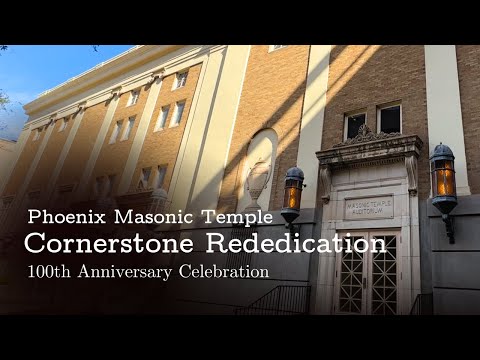
Phoenix Masonic Temple rededicated at 100-year ceremony
Get AI-powered insights, summaries, and transcripts
SubscribeSummary
Members of the Grand Lodge of Arizona and city officials marked the 100th anniversary of the Phoenix Masonic Temple with a rededication ceremony that included historic remarks, a time-capsule reference and tributes to restoration efforts that preserved the 1925 building.
Michael Andrew Dale, most worshipful grand master of the Grand Lodge of Arizona, opened the rededication ceremony for the Phoenix Masonic Temple and led the congregation through traditional Masonic rites, including the ceremonial testing of the cornerstone and prayers invoking ‘‘the great architect of the universe.’'
The ceremony recalled the temple’s origins: a lot purchased in 1923 for $25,000, bonds issued in the 1920s ‘‘totaling over a $100,000’’ to finance construction, the laying and testing of the cornerstone in 1925, and Arizona Lodge No. 2’s move into the building on Nov. 29, 1925. Dale said the cornerstone ‘‘was tested and found to be square, level, and plumb,’’ language the lodge used to connect physical workmanship to Masonic moral teachings.
The event included brief addresses from public officials and preservation partners. District 1 Vice Mayor Anne O’Brien, representing the city of Phoenix, said she was honored to attend and spoke of family connections to Freemasonry: ‘‘It is such an honor and privilege to be able to join you in this rededication of this incredible building,’’ she said, describing masonry as ‘‘family’’ and praising the temple’s role in community bonds.
Steve Schumacher, the city of Phoenix official historian, placed the 1925 construction in local context, noting Phoenix then had roughly 30,000 residents and describing the early downtown street layout and civic institutions. Schumacher also traced the Masons’ earlier meeting places and encouraged preservation of the city’s built heritage.
Tyler Vance, director of collections at the George Washington Masonic National Memorial in Alexandria, Virginia, praised the Phoenix temple as ‘‘one of the finest Masonic temples ever constructed’’ and emphasized the role of such buildings in preserving and communicating Masonic history and charitable activity to the public.
Speakers at the ceremony recounted episodes in the temple’s history: temporary loss of the building during the Great Depression and its repurchase in 1941; registration as a historic property in the 1990s that prevented a redevelopment takeover; more than $1 million invested in restoration around 2000; a 2017 renovation of the Blue Room; and further structural, roof and window work described as continuing through recent years. Organizers also noted a sealed copper time capsule placed behind the original cornerstone remains unopened.
Relatives of early Phoenix civic leaders spoke about family ties to the building. Matthew Crane, a descendant of businessman George Luhrs, described the Luhrs family’s historical role in downtown Phoenix and urged continued preservation: ‘‘I just implore everybody to really appreciate beautiful buildings like this, because once they’re all gone, we don’t get them back,’’ he said.
Event organizers thanked volunteers and preservation partners by name and affirmed the temple’s ongoing use by multiple Masonic lodges. The Grand Lodge and local lodges present pledged continued stewardship of the building as a functioning Masonic center and community landmark.
The ceremony closed with a final prayer and an invitation for attendees to continue observances inside the temple and for Masonic members to conclude internal proceedings afterward.