Get Full Government Meeting Transcripts, Videos, & Alerts Forever!
Get email alerts on the School Nutrition topic
No spam. Unsubscribe anytime.
New Albany-Plain Local to hold federal nutrition audit; district to keep meal prices flat for 2025-26
Summary
Superintendent Michael Sawyers told the board the district will undergo a federal and state audit of its school nutrition program beginning in August and recommended keeping meal prices unchanged for 2025-26. He reviewed meal counts, federal meal-component rules, sourcing and self‑sustaining finances.
Superintendent Michael Sawyers told the New Albany-Plain Local Board of Education on June 30 that the district will undergo a formal review by the Ohio Department of Education and federal auditors beginning in August and recommended holding child nutrition prices steady for the 2025-26 school year.
The audit, Sawyers said, will examine compliance across meal quantity, quality and nutritional requirements for reimbursable meals. “So beginning in August, we will go through the formalized review process with the Ohio Department of Education and workforce,” Sawyers said. He added that the federal rules require public reporting of year-end data the district will present to the board.
Board members were given the core details of program operations and recent results. For 2024-25 the district reported serving about 451,198 meals districtwide and an average of roughly 3,500 meals per day. Breakfast participation rose from 55,113 in 2023-24 to 71,516 in 2024-25 after a push to increase access. Sawyers said the district will recommend that breakfast and lunch prices remain the same for 2025-26: breakfast a la carte $1.50; elementary lunch $2.50; intermediate $2.65; middle and high school $2.75; upgraded lunch with 20‑ounce drink and extra item $3.50; milk 75¢; bottled water 50¢.
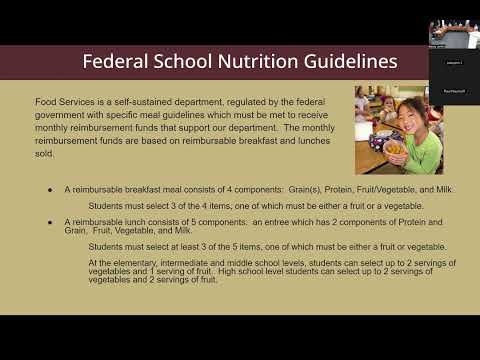
Sawyers described the federal meal-component requirements that determine whether a breakfast or lunch is reimbursable: a reimbursable breakfast must include four components (grain, protein, fruit/vegetable, milk) with students taking at least three, one of which must be a fruit or vegetable; a reimbursable lunch has five components and students must select at least three, including a fruit or vegetable. He explained portion-size controls driven by grade and color-coded scoops used by food-service staff to meet calorie and age-based limits.
On food sourcing, Sawyers said the district’s primary vendor is GFS for many items and commodity foods, though the food-services coordinator seeks local vendors when feasible (for example, seasonal apples). He noted pandemic-era fuel surcharges remain on invoices and affect purchasing decisions. The district also operates cook lines and produces some condiments (Sawyers said food service “makes our own yum yum sauce” to meet sodium and sugar limits).
Sawyers described food services as a self-sustaining operation: meal revenue covers 100% of food-service personnel and program costs and the department reinvests year-end balances into equipment and capital projects. He said last summer the district spent “over a million dollars” refurbishing the high school and middle school kitchens out of food-service reserves; food service also holds roughly $600,000 in line items earmarked for new equipment for the upcoming elementary building. Sawyers invited board members to ask questions at the August student-services update, when the food-service coordinator will present additional details.
The superintendent emphasized compliance and documentation for the incoming audit and encouraged patience with summer communications; he said the district’s web pages and principals will post back-to-school information after Aug. 1.