Get Full Government Meeting Transcripts, Videos, & Alerts Forever!
Get email alerts on the Roots To Roofs topic
No spam. Unsubscribe anytime.
'Roots to Roofs' pilot briefed to committee; supporters cite housing gains, public commenters press tree protections and displacement concerns
Summary
Central staff and sponsors briefed the committee on Council Bill 12101011, the 'Roots to Roofs' pilot to incentivize community-led affordable housing; the proposal drew both support from housing advocates and developers and multiple public comments urging stronger tree protection, environmental and displacement safeguards.
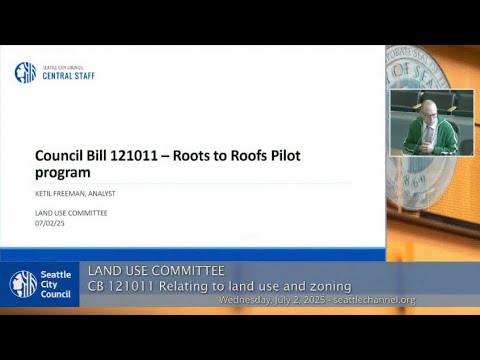
City central staff and council sponsors briefed the Seattle Land Use Committee on July 2 about Council Bill 12101011, known as the Roots to Roofs pilot program, a citywide proposal to provide development incentives for qualifying community-led affordable housing and civic uses.
Keto Freeman of Council Central Staff described the program’s structure: eligible developments would need to provide at least 25% of units as affordable for up to 50 years, with affordability levels ranging from about 40% of area median income for very small units to 80% for two-bedroom units. Freeman said qualifying organizations would include nonprofits, public development authorities and public housing authorities; participating projects could receive additional height, floor-area-ratio (FAR) increases, exemptions and an FAR exemption of up to 1.0 for certain institutional or commercial “equitable development uses.” Freeman also said the bill would exempt qualifying projects from design review and parking minimums, and that the Office of Planning and Community Development, Seattle Department of Construction and Inspections and the Office of Housing would be directed to promulgate rules to administer the pilot. Freeman described the proposal as a time- and project-limited pilot with a deferred effective date while implementing rules are adopted; he said it would expire “in about 10 years or after 35 qualifying projects apply.” (Sponsors at one point also referred to an end date phrased as “the end of 2035” when discussing the pilot’s terminal date.)
Councilmember Rink introduced the briefing and said the pilot is intended to “demonstrate the social benefits of equitable development” and to incentivize community-serving uses and housing serving a spectrum of incomes. Councilmember Barrick said his office rewrote portions of the earlier proposal after stakeholder feedback and described changes including adjusted height and FAR numbers, a community-preference policy to prioritize vulnerable populations and a forthcoming amendment on an owner-unit incentive to help legacy homeowners retain equity. Chair Mark Solomon said he is a cosponsor and urged the committee to move the proposal to produce housing sooner.
Housing advocates and builders offered public support at the meeting. Jesse Simpson of the Housing Development Consortium said the pilot “will help our members deliver more affordable housing” by allowing some projects to build an extra story and increase development capacity. Parker Dawson of the Master Builders Association also spoke in strong support and praised the stakeholder process.
Several in-person and remote public commenters urged changes to protect tree canopy, green space and community health and to guard against displacement. Sandy Schettler and June Bruce Roost urged that the pilot include requirements or incentives for tree retention and new, large-tree planting, citing public-health research linking tree canopy to improved respiratory and cardiovascular outcomes. Ruth Williams and Richard Ellison similarly urged tree protections and open space; Ellison suggested incentives for retaining existing large trees and argued that low-income housing should not be “treeless.” Lois Martin, a longtime Central District resident and early-learning center director, urged the committee to reject the bill in its current form, saying it risks benefiting organizations that become landlords rather than legacy residents and lacks pathways to homeownership, tree protection and a full racial and environmental analysis.
Central staff said the city’s tree code would still apply to qualifying projects and that replacement requirements in the tree code remain in force; Freeman acknowledged that greater development capacity can increase the likelihood of tree removal but said replacement and tree-code modification processes apply. Staff also said the pilot is designed to address timing concerns by offering a path for some projects to proceed before comprehensive plan zoning changes take effect; sponsors argued the pilot could bring projects online sooner than waiting for comp-plan implementation.
The committee set a public hearing for July 30, 2025; central staff said the committee could vote at that meeting or at a subsequent meeting in August. Sponsors said they expect to circulate a narrow amendment related to the owner-unit incentive before the next hearing. No committee vote was taken July 2.
The briefing included technical and policy details that will be refined in subsequent committee meetings and during rulemaking by SDCI, OPCD and the Office of Housing.