Commission approves industrial revenue bonds for two solar-and-storage projects
Loading...
Summary
San Juan County approved industrial revenue bond ordinances for four related renewable-energy projects — two solar-generation and two battery-storage facilities — developed by affiliates of DE Shaw Renewable Investments.
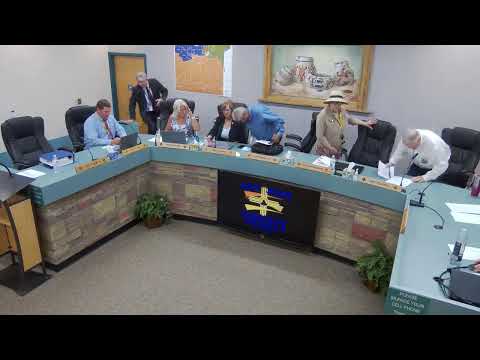
The San Juan County Commission approved ordinances authorizing industrial revenue bond (IRB) structures for four related renewable-energy projects — two solar-generation projects and two battery-storage projects — to be developed by affiliates of DE Shaw Renewable Investments.
Attorney Peter Kelton, representing the county for the transactions, explained IRBs are an economic development device that allow exemptions from gross receipts, compensating and property taxes by having the county hold title and lease the project assets back to the developer; the developer pays payments in lieu of taxes (PILOTs) and other negotiated community benefits. Kelton said the State law and prior inducement resolutions had set initial capacity at roughly $621 million and had been amended to an aggregate of about $833 million to accommodate project scaling; bond terms would be up to 30 years.
The developer team proposed upfront community benefit payments and annual PILOT schedules. Kelton described aggregate community benefit payments of at least $1.5 million to San Juan College and $1.2 million to the San Juan County Fire Department (subject to potential upsizing to $1,609,662 under the scaling mechanism). He summarized projected PILOT amounts: for the first 10 years an estimated $922,000 in aggregate (split between county and school districts) with potential to grow to $1,236,757 if upscaling is exercised; years 11–30 were estimated at $325,000 annually (with potential to increase to $435,950). Kelton explained statutory methods under Section 4-59-4.2B/C for allocating PILOTs to counties and school districts and provided a draft allocation among Aztec, Central Consolidated, Farmington and Bloomfield school districts for planning purposes.
Kelton described the two Foxtail Flats ordinances (solar and storage) separately from the Fourmile Mesa ordinances and asked the commission to consider them individually; the commission opened public comment but none appeared. Following discussion of community benefits, school-district allocations and tribal site leases for portions of the project on Ute Mountain Ute land, commissioners voted to approve the Foxtail Flats ordinances and then the Fourmile Mesa ordinances. Kelton said closings would occur no sooner than 30 days after ordinance recordings and would finalize PILOT allocations at closing.