Get Full Government Meeting Transcripts, Videos, & Alerts Forever!
Get email alerts on the Public Safety Fire topic
No spam. Unsubscribe anytime.
Consultants detail gaps, staffing phases and infrastructure needs in Consolidated Fire District 1 evaluation
Summary
Consultants from Emergency Service Consulting International presented a high‑level agency evaluation of Consolidated Fire District 1 to the Douglas County Commission, identifying staffing shortfalls, equipment and facility needs, and recommending a phased approach to hiring and infrastructure investment.
Consultants from Emergency Service Consulting International on Wednesday presented a high-level agency evaluation of Consolidated Fire District 1 to the Douglas County Commission, identifying staffing shortfalls, equipment and facility needs, and recommending a phased approach to hiring and infrastructure investment.
The report, delivered by consultant Jeff Stone of Emergency Service Consulting International (ESCI) and project team member Joanne Lorber, reviewed department structure, service delivery, response performance and apparatus. “When somebody calls 911, there’s an expectation that somebody’s going to come,” Stone said, adding that response-time goals and staffing levels must be balanced against available funding.
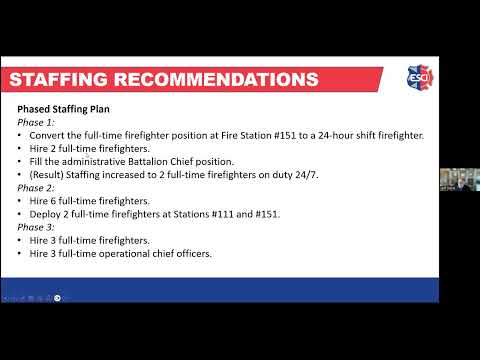
The consultants recommended a three‑phase staffing plan the report describes as funding‑dependent: convert existing full‑time firefighters to 24‑hour shifts and hire two additional firefighters in an initial phase; add six more full‑time firefighters to staff two additional apparatus in the second phase (with suggested placements at stations 111 and 151); and add three more full‑time firefighters and a proposed operational chief or battalion chief in a third phase. Stone told commissioners the report’s baseline principle is that engines should carry at least two personnel for safety.
The team also flagged technology and operations improvements: implement an automatic vehicle location (AVL) system tied to the county dispatch CAD, ensure the portable radio emergency‑button function is programmed and tested, and standardize departmental email domains and public recruitment materials. Joanne Lorber suggested restoring a year‑long training calendar, formalizing a training committee that includes volunteers and career staff, and making standard operating procedures and guidance documents digitally accessible.
On apparatus and facilities, consultants said agencies nationwide face long lead times and high costs: engine replacements approach $1 million and ladder trucks $2–2.5 million, and delivery times can be years. The report urges a capital replacement plan with budgets and timelines, a review of fleet redundancy, stronger maintenance schedules and consideration of hiring an emergency vehicle technician. The consultants recommended installing vehicle exhaust removal systems in stations where personnel live, upgrading signage and decommissioning or relocating aging or leased facilities when legally and operationally appropriate; the presentation specifically mentioned ending a monthly lease with Lone Pine Farms and decommissioning Station 152, subject to legal and operational review.
Consultants also raised training and credential recommendations: update recruit and officer task books to current techniques, provide driver and leadership modules, and ensure personnel assigned to wildland response obtain Red Card wildland certifications. The report urged development of a strategic plan with measurable goals and a five‑ to ten‑year master plan for infrastructure and apparatus needs.
Commissioners and district leaders treated the evaluation as a starting point for broader countywide discussion. Commissioner Milley said many report items require conversations beyond Consolidated Fire District 1 because other districts and Lawrence‑Douglas County Fire Medical (LDCFM) are part of the county’s fire/EMS ecosystem. “To really get much further with what’s in this report, it’s really not just talking about Consolidated Fire District 1,” Milley said.
Several commissioners and the interim chief stressed the need to prioritize “low‑hanging fruit” and identify what is feasible within existing budgets. The chief told the commission that filling an open administrative battalion chief position is a high priority to reduce shared duties that are overwhelming senior staff. Commissioners also discussed the potential for cross‑jurisdictional workforce analyses as LDCFM examines staffing reductions while CFD 1 seeks to staff up.
The commission and staff asked consultants and county staff to return with suggested next steps, including a prioritization of recommendations, an analysis of which items could be addressed within current funding, and identification of which recommendations require countywide coordination with other fire districts and communications/dispatch. Sean (county staff, project lead) described the evaluation as “all the spaghetti on the table” and said staff will work with department leadership on next steps.
No formal action was taken at the work session; work sessions are informational only. Commissioners invited public engagement and directed that members of the public may submit comments to the commission; staff were asked to collect feedback and prepare a recommended work plan for future commission discussion.
The ESCI report and the consultants’ recommendations will be part of follow‑up conversations about staffing, capital planning and countywide coordination among fire and EMS providers.