Get Full Government Meeting Transcripts, Videos, & Alerts Forever!
Get email alerts on the School Discipline Cellphone Policy topic
No spam. Unsubscribe anytime.
Board advances new district cell-phone policy; K–8 phones to be stored, high school use limited to instructional periods
Summary
The board approved second reading of a new electronic-communications policy that requires K–8 students to keep devices securely stored during the school day and allows high school students limited, supervised device use during instruction and transition times.
The Moorestown Township Board of Education advanced a new district policy on electronic communications and smart devices (policy 5516) in its second-reading vote.
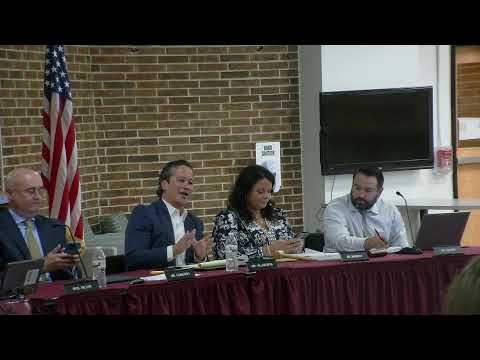
Claudi ne Murano, who led the policy committee, summarized changes made between first and second reading and said the policy adopts an “away for the day” approach for kindergarten through eighth grade: devices, including smart watches, must be “securely stored away” during the school day. Murano said schools may define what “securely stored” means for their buildings (for example, lockers or backpacks) and that principals requested removing an explicit bell-to-bell reference so that staff can address device use as students enter a building.
For high school, Murano said the policy focuses on device use tied to instruction: “That language is a way for instructional periods, which includes study halls. There's permitted use and responsible use that we want to, you know, encourage for our kids to learn responsible use.” The policy also preserves prohibitions on recording individuals in school spaces and specifically prohibits use in locker rooms and bathrooms. Exceptions for instructional needs, IEP/504/IHP accommodations and first-responder volunteers were included.
Murano told the board the policy committee consulted administrators, faculty, the MEA and some students, benchmarked other districts and left discipline to each building’s code of conduct. She noted the board may revisit the policy, especially the smart-watch rules for high school, after implementation.
The board voted to approve the two policies on second reading as part of the superintendent's recommendations. The policy committee will monitor implementation and principals will include discipline language in building codes.