Get Full Government Meeting Transcripts, Videos, & Alerts Forever!
Get email alerts on the Traffic Calming Bowling Ave topic
No spam. Unsubscribe anytime.
NDOT presents traffic-calming plan for Bowling Avenue; neighbors raise safety and diversion concerns
Summary
The Nashville Department of Transportation presented a preliminary traffic-calming plan for a roughly 0.4-mile segment of Bowling Avenue on Oct. 12, saying engineering changes could reduce speeds on a street where speed data and neighborhood uses indicate safety concerns.
The Nashville Department of Transportation presented a preliminary traffic-calming plan for a roughly 0.4-mile segment of Bowling Avenue on Oct. 12, saying engineering changes could reduce speeds on a street where speed data and neighborhood uses indicate safety concerns.
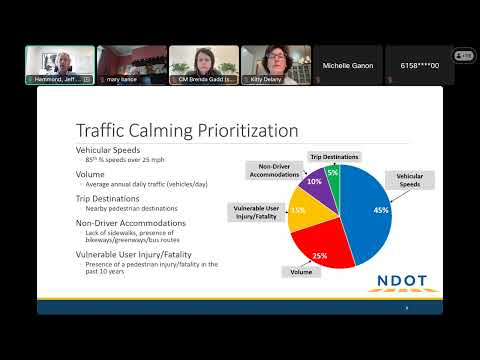
At a virtual neighborhood meeting, Jeff, a consultant for the Nashville Department of Transportation (NDOT), said the city selected Bowling Avenue from an application-based backlog of roughly 600 streets and that the corridor scored in the top 25 for the current selection cycle. He described 80th-percentile speeds of 32 mph, a recorded daily traffic volume of about 3,800 vehicles, and said NDOT uses a 24-hour count window to generate those metrics. "These meetings are recorded. We'll make this available to you, really to anyone through the NDOT traffic calming website," Jeff said as he opened the session.
Why it matters: Residents identified school pick-up and the nearby synagogue as concentrated pedestrian activity that could be affected by high vehicle speeds; several speakers said children wait at bus stops along Bowling and that sight-distance over a crest is a recurring hazard. Neighbors also warned that slowing Bowling could push traffic onto narrower nearby streets such as Greenway and Craighead.
NDOT’s preliminary design and toolbox NDOT staff presented a preliminary layout that would place two sets of speed cushions on the long uninterrupted stretch between Central and Murphy, with target spacing in the roughly 300–450-foot range. Jeff described speed cushions as 3 inches tall, manufactured from recycled rubber, and available in different lengths: about 7 feet for the most pedestrian-heavy urban locations, a 10.5-foot standard, and up to 14 feet in lower-density areas. He said NDOT typically installs cushions on residential streets with up to 5,000 cars per day.
Other tools NDOT showed included radar feedback signs, pavement striping or visual narrowing, bulb-outs or delineators in constrained areas, and — less commonly — speed tables, chicanes or traffic circles depending on context. Jeff said the agency prefers physical measures that drivers must “drive over or around” because they yield more consistent speed reduction than signage or enforcement alone. He added NDOT is coordinating with Metro Police on enforcement and with emergency services for operational review.
Community concerns and site conditions Residents raised several recurring concerns. Some said drivers accelerate to "catch the green" at West End and cross the Richland and Central intersections at high speed; others described delivery trucks and vehicles parked in the travel lane creating conflicts. Multiple commenters asked whether cushions would worsen cut-through traffic on Greenway or Craighead; one resident said a fatal crash occurred near Greenway about 12 years ago.
Helen Barber, who identified herself as living at 105 Bowling Avenue, described near-miss incidents when vehicles crest the hill from West End. "I cannot tell you the number of times I have almost been hit by people flying over that hill," Barber said, urging cushions between Central and Murphy to address the blind-crest hazard.
NDOT answers and constraints Jeff said NDOT had not yet done in-person field checks for grade limits but noted the agency avoids placing cushions on slopes steeper than 5% (and never on grades steeper than 8%). He also said some design choices (for example cushion length and spacing) can be tuned to target lower speeds while allowing emergency vehicles to pass; NDOT officials said they have consulted Chief Swan and emergency operations staff and that emergency responders have not identified any street where cushions would be a project “deal killer.”
On signage and truck routing, Jeff confirmed that trucks are allowed on streets that are not posted as "no truck routes." Posting a route requires action by the Traffic and Parking Commission; NDOT staff said they would forward a request to explore truck restrictions and other signage.
Decision process, ballot and timeline NDOT described the program’s next steps: the project team will use neighborhood feedback to refine the design, then the agency will conduct an online ballot for property owners whose land abuts the affected right-of-way. Ballots are open six weeks and require a two-thirds majority of respondents in favor for the project to proceed. Jeff said if a proposal fails, NDOT typically offers a "Plan B" (often a radar feedback sign) rather than moving immediately to construction. He estimated a best-case timeline from design to construction of roughly 10 months to a year and said NDOT typically implements 50 traffic-calming projects per year (25 per selection window).
How residents can participate NDOT staff urged residents to submit comments through the project page (engage.nashville.gov) and by email; the session recording and slide materials will be posted on the NDOT traffic-calming website. Staff said they expect to return with a revised plan and chart a schedule for the ballot after collecting neighborhood input.
Remaining issues raised at the meeting included: the potential for traffic diversion to narrower side streets, whether cushions will reduce incidents of stop-sign roll-throughs, visibility on crests, the presence of heavy trucks, and whether the project can be divided so only targeted blocks receive cushions. Jeff said he would ask NDOT whether the corridor could be split into separate ballot segments and would follow up on truck restrictions and emergency-services review.