Get Full Government Meeting Transcripts, Videos, & Alerts Forever!
Get email alerts on the Traffic Calming topic
No spam. Unsubscribe anytime.
NDOT proposes three speed-cushion locations and intersection bulb-outs for April Lane after 85th-percentile speed measured at 37 mph
Summary
NDOT presented a draft traffic‑calming plan for April Lane at a June 23 virtual meeting, proposing three sets of speed cushions and corner bulb‑outs after speed monitoring found an 85th‑percentile speed of 37 mph and roughly 400 vehicles per day.
NASHVILLE — The Nashville Department of Transportation (NDOT) presented a draft traffic‑calming plan for April Lane at a June 23 virtual meeting, proposing three sets of speed cushions and corner bulb‑outs after data collection showed an 85th‑percentile speed of 37 miles per hour on the short block.
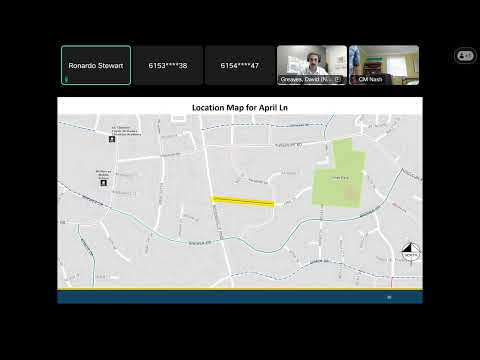
NDOT engineer David Greaves, who facilitated the meeting, said the street had an about 85th‑percentile speed of 37 mph and a daily volume of roughly 400 vehicles. "This is a program that focuses on residential streets," Greaves said while describing tools intended to reduce speeds and improve safety under the city's Vision Zero goal. The project area is roughly bounded by Nolensville Road and Raywood Lane.
The proposal and why it matters
NDOT's draft concept places three sets of speed cushions spaced along April Lane — each set roughly 250 feet from the ends and one near the middle — and recommends bulb‑outs at the April Lane–Raywood Lane intersection to reduce turning radii. Greaves said speed cushions and tables are NDOT's most common measures because they lower speeds over long lengths and can be traversed by emergency vehicles.
Greaves framed the work as part of a data‑driven selection process: NDOT used short‑duration speed tube counts, vehicle volumes, proximity to potential pedestrian trip generators (parks, schools), presence of sidewalks and prior crash data to rank applicant streets. "In March of 2025, when April Lane was selected, you were one of 600 or 600 plus streets who had applied for traffic calming," he said.
What residents told NDOT
Longtime resident Renardo Stewart said drivers have used April Lane "as a little quarter mile race track" for decades and welcomed physical measures. "People have always treated that street as a quarter mile racetrack," Stewart said.
Neighbor Wayne Bayfar described observing even higher speeds than the measured 85th percentile and urged three cushions — "1 in the middle, 1 near the intersection of Raywood and April Lane and 1 up at the beginning of April Lane" — saying, "I've seen people doing 50 miles an hour on this little short stretch of road." Several residents in the meeting signaled support for the draft layout and volunteered to inform neighbors about the upcoming ballot.
Program tools, outreach and ballot details
NDOT staff reviewed typical traffic‑calming tools: modular rubber speed cushions (about 3 inches high and 6 feet wide), speed tables, radar feedback signs (solar‑powered displays that show driver speed), pavement narrowing with painted edge lines, bulb‑outs at corners and larger traffic circles where appropriate. Greaves noted prior local results: a March 2023 NDOT study of six projects saw average speeds drop from 31 to 22 mph after cushions were installed.
As a next step NDOT will perform a site visit, complete construction plans and either hold a second neighborhood meeting or proceed directly to an online ballot. Property owners whose parcels abut the affected right of way will receive a postcard with a unique ID; ballots are open for six weeks and the project advances if two‑thirds of respondents vote yes. NDOT staff said a phone line will be available to submit ballots for residents who prefer not to use the online form.
Timing and limits
NDOT staff said the installation schedule depends on construction queues and repaving schedules; a typical range to construction after approval is about eight to ten months, though individual projects can move faster if they coincide with repaving. The proposed plan notes April Lane's pavement width (about 20–21 feet), which constrains some options such as chicanes; NDOT indicated cushions are the leading candidate given the narrow cross section.
What was not decided
No formal vote occurred at the meeting. NDOT will return with final plans and follow the ballot process described above; construction will proceed only after the neighborhood voting threshold is met and funding/queueing permits. Residents asked about inclusion of renters; NDOT clarified the mailer is sent to property owners listed in Metro public records and the owner receives the ballot.