Get Full Government Meeting Transcripts, Videos, & Alerts Forever!
Get email alerts on the Traffic Calming topic
No spam. Unsubscribe anytime.
NDOT outlines speed-cushion plan, centerline striping for Woodlands Avenue; neighborhood ballot next
Summary
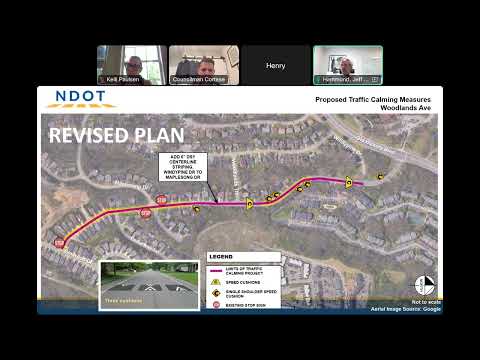
At a virtual neighborhood meeting hosted by the Nashville Department of Transportation, Jeff Hammond, a consultant working on NDOT’s traffic calming program, presented a revised plan for Woodlands Avenue from Boxwood at the top of the hill to Windy Pine at the bottom.
At a virtual neighborhood meeting hosted by the Nashville Department of Transportation, Jeff Hammond, a consultant working on NDOT’s traffic calming program, presented a revised plan for Woodlands Avenue from Boxwood at the top of the hill to Windy Pine at the bottom.
The plan centers on two full-width speed-cushion locations, a series of single cushions in the road shoulder to discourage corner-cutting, and a continuous double solid yellow centerline along the project length. Hammond said the design reduces the originally proposed four full-speed-cushion sites to two “being very cognizant of where the beginning and the ending of hills were,” and retains shoulder cushions in curves to reduce drifting into pedestrian areas.
The revision responds to neighborhood comments about winter safety and pedestrians using the shoulder where sidewalks are absent. “This has been a project long, long time coming,” Hammond said. He also described the program as dominated by one tool: “Our program is quickly become the speed cushion program because we do use this way more than any other tool that we have.”
Hammond described three main elements of the design: two full-width speed-cushion assemblies that drivers must traverse; single cushions placed in the shoulder at the inside of curves so motorists are discouraged from cutting corners; and new double solid yellow centerline striping that will establish two 10-foot travel lanes. He said the centerline will run the full project length where an existing short section already exists.
Hammond pointed to specific locations in the full design plans: one shoulder cushion would be placed about 120 feet north of the Windy Pine intersection; another reference in the plans showed a cushion 26 feet north of a nearby driveway, which Hammond said keeps the cushions well away from driveways and follows NDOT protocol of maintaining at least 15 feet from driveways. He noted the set of four cushions for a wider street portion is laid out with one cushion centered in each travel lane and one in the shoulder.
Neighborhood speakers asked practical and scheduling questions. One resident asked whether cushions would be placed in front of driveways; Hammond replied they would not and that the project follows the usual driveway clearance protocol. Another resident asked whether the shoulder could be painted as a pedestrian walkway; Hammond cautioned that designating a painted walkway could trigger ADA considerations and cause conflicts because residents use the shoulder for parking, yard maintenance, and trash placement.
On next steps, Hammond said NDOT and the consultant team will post the full design plans and a recording of the meeting on the NDOT traffic-calming website and then proceed to a six-week ballot process for affected homeowners. He described the ballot period as the next formal outreach step and said construction would follow, subject to the construction queue. “That construction queue we show here, it’s 8 to 10 months,” Hammond said, while noting some projects have moved faster.
Residents and a councilmember on the call asked staff to make the meeting recording and design plans available before ballots are mailed. A resident asked, “When will the link be live?” and the group agreed to wait to begin the ballot process until the link and plans have been posted and homeowners notified. Hammond said he would forward the materials to NDOT for posting and to the neighborhood contact list.
The presentation and subsequent discussion focused on design details, pedestrian considerations, driveway clearances, and outreach timing. No formal vote or legislative action was taken at the meeting; the next procedural step agreed on the record was posting the materials and starting the six-week ballot after homeowners confirm access to the materials.
Plans, meeting recording, and ballot materials will be posted on NDOT’s traffic-calming web page when available; the project schedule will depend on the ballot outcome and NDOT’s construction queue.