Get Full Government Meeting Transcripts, Videos, & Alerts Forever!
Get email alerts on the Traffic Calming topic
No spam. Unsubscribe anytime.
NDOT proposes six speed cushions, radar signs for Heights Ferry Road after neighborhood meeting
Summary
At a June 26 neighborhood meeting, an NDOT engineer outlined a draft plan for traffic calming on Heights Ferry Road — six speed-cushion locations on the northern segment, radar feedback signs on the southern segment — and described the neighborhood ballot and timeline for installation.
David Greaves, an engineer who works with the Nashville Department of Transportation’s traffic calming program, presented a draft design and next steps for a traffic-calming project on Heights Ferry Road at a neighborhood meeting on June 26, 2025.
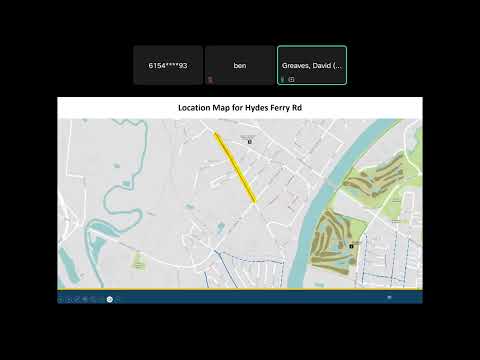
Greaves said the project area under study runs from County Hospital Road north to John Mallett Drive and that NDOT’s preliminary design proposes six sets of speed cushions in the northern section and radar feedback signs on the portion south of County Hospital Road. "These are kind of the go-to because they physically make speeding, like, uncomfortable," Greaves said of speed cushions.
The meeting focused on why the street was selected and which tools NDOT can use. Greaves said Heights Ferry was one of more than 600 neighborhood streets that applied to the city’s traffic calming program earlier in 2025 and was ranked in the top 25 by a prioritization metric that combines vehicle speeds, traffic volume, crash history, presence of sidewalks, and nearby trip destinations such as parks or schools.
Greaves reported field measurements showing an 85th-percentile speed of about 36 miles per hour on the northern section and average daily traffic around 500 vehicles per day. He described design details for the treatments: speed cushions about 3 inches tall and 6 feet wide, spaced roughly 300–500 feet apart (his plan uses roughly 400-foot spacing), and radar feedback signs that typically reduce speeds by an average of 6–7 mph in prior installations. He referenced a 2023 limited study of six projects that, on average, reduced mean speeds from 31 to 22 mph and 85th-percentile speeds from 37 to 25 mph.
Greaves said vertical measures such as speed cushions are not feasible on the southern segment of Heights Ferry Road because of heavy truck traffic tied to nearby commercial and river-loading activity; those trucks risk damaging vertical installations. For the southern section he proposed radar feedback signs and noted existing bulb-outs at the southernmost end of the corridor that were installed previously.
Residents raised concerns about weekend racing, stolen vehicles being driven on the street, repeated pavement patches and requests for repaving, and a narrow section of roadway that requires careful passing. One resident said she could "hear it over in the morning at night when they're really, you know, they're really...booming on the street." Crystal Cunningham, a resident at 3715 Heights Ferry, said she did not want another meeting before the ballot and was "fine without another meeting." Greaves said NDOT will consider striping changes for a complicated commercial driveway at the north end but cannot narrow a legal commercial curb cut because of property-rights limitations under state law.
Greaves described the program’s next steps: a site field review, refinement of the concept into construction plans, and an online ballot to be mailed to property owners along the affected segment. Ballots will be open for six weeks; the project moves forward if two-thirds (66%) of ballots cast are yes votes. Greaves said construction would enter the queue and likely occur about eight to ten months after successful voting. If residents prefer, NDOT may post final plans online instead of holding a second neighborhood meeting before the ballot mailing.
No formal actions or votes were taken at the meeting. Greaves provided contact information and directed residents to the Engage Nashville traffic calming survey page and to email david.greaves@kimleyhorn.com with a copy to n.trafficcalming@nashville.gov for follow-up or missing ballot mailers.