Get Full Government Meeting Transcripts, Videos, & Alerts Forever!
Get email alerts on the Traffic Calming topic
No spam. Unsubscribe anytime.
NDOT presents traffic-calming plans for Albion, 30 Second and 30 Third; ballots to go to property owners
Summary
The Nashville Department of Transportation detailed designs for speed cushions, radar feedback signs and possible traffic circles on Albion Street and the 30 Second and 30 Third corridors, and explained the property-owner ballot process that will decide whether projects move to construction.
Amy Birch, a traffic engineer and consultant working with the Nashville Department of Transportation, outlined plans for traffic calming on Albion Street and the 30 Second and 30 Third corridors and described how the city’s ballot process will determine whether the projects proceed to construction.
Birch said the traffic-calming program is intended to reduce vehicle speeds on residential streets and tied the work to Nashville’s Vision Zero commitment. "There's a really close correlation between safety and speed," Birch said, noting the presentation’s survival-rate graphic showing an 89 percent chance of survival for a pedestrian struck at 25 mph and lower survival rates at higher speeds.
The presentation described the program’s selection and scoring process. NDOT staff said the program received more than 600 street applications in the most recent selection and that staff selects about 25 streets based on a 100‑point scoring system. Birch said speed accounts for 45 percent of the score, non‑driver accommodations (sidewalks, bike and transit access) about 15 percent, trip destinations 5 percent, and a 10‑year record of vulnerable‑user injuries and fatalities is also considered.
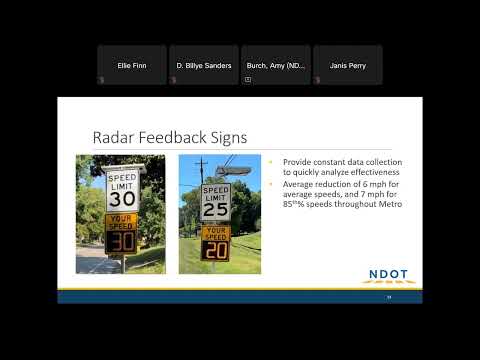
NDOT recommended tools for the three projects that include modular speed cushions, radar feedback signs, pavement‑narrowing markings, alternating parking patterns to create horizontal curvature, and, where feasible, small traffic circles. The presentation showed local before‑and‑after data from a past installation on Sixth Street: average speeds fell from 31 mph to 22 mph and the presenter reported an 80th‑percentile reduction (from about 37 mph to roughly 20 mph in the study shown).
Staff gave street‑level data used to justify selection and design choices. For example, the 80th‑percentile speed measured on Albion was reported as 42 mph; NDOT showed a concept plan for Albion with six sets of cushions spaced roughly every 400 feet where feasible and with signage and pavement markings. On 30 Second and 30 Third, the steep grades constrain where cushions can be placed, so designs combine cushions where possible with radar feedback signs and, at a few intersections, exploration of small circular islands to improve visibility and reduce speeds.
Residents at the meeting raised visibility and sight‑line concerns at some intersections and asked whether stop signs, trimmed vegetation, or circles might be appropriate. Birch and other staff said all those options can be evaluated: stop signs are reserved for certain traffic‑control needs, vegetation trimming or crosswalk upgrades may address visibility issues, and traffic circles can be considered where intersection geometry allows.
NDOT staff described the community balloting process that must follow design. Ballots are mailed to eligible property owners abutting the affected right of way (one vote per property). NDOT staff said Albion has 26 eligible properties; 30 Third about 37 eligible properties; and 30 Second about 51 eligible properties. Ballots include a unique ID and a QR code; a two‑month (six‑week) window is typical for voting. Birch said that if two‑thirds (66%) of returned ballots from eligible properties are in favor, the project proceeds to construction. Construction timing described by staff ranges from about six to eight months after ballot passage, with the full timeline from selection to installation typically around a year.
Residents and staff also discussed likely effects on cut‑through traffic and truck movements. Staff said larger trucks find cushions less comfortable and that some drivers do change routes once cushions and other measures are installed; residents asked NDOT to consider whether the new devices will shift problem traffic onto nearby streets and asked staff to study potential extensions of project limits northward in some locations.
NDOT staff directed attendees to online resources for more information and next steps: the traffic‑calming tracker and project pages (trafficcalming.nashville.gov and engage.nashville.gov/traffic‑calming). "We record these meetings... we post them on our website," Birch said; recordings and detailed plans will be posted shortly after the meeting. Staff said they will finalize detailed designs, post updated plans online, and mail ballots when ready.
What happens next: NDOT will prepare detailed design plans for 30 Second and 30 Third (including further study of circles and intersection visibility), finalize the Albion concept after minor adjustments discussed at the meeting, and mail ballots to eligible property owners. If ballots meet the 66 percent approval threshold, NDOT will schedule construction ordering and installation.