Get Full Government Meeting Transcripts, Videos, & Alerts Forever!
Get email alerts on the Municipal Budget topic
No spam. Unsubscribe anytime.
St. Pete Beach committee reviews preliminary proposed budget, flags FEMA, insurance and parking transfers as major revenue drivers
Summary
The Finance and Budget Committee reviewed a preliminary proposed budget that relies on FEMA reimbursements, insurance recoveries and a newly isolated parking fund; staff outlined reserve targets, a 2.6% cost‑of‑living adjustment and tighter controls to discourage year‑end “spend down.”
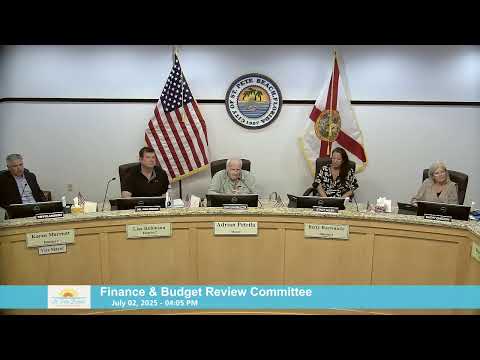
The St. Pete Beach Finance and Budget Committee reviewed the city’s preliminary proposed budget and the assumptions behind its revenue and spending forecasts during a July workshop.
Committee members and staff said the budget reflects recent disaster reimbursements and insurance recoveries and includes a newly created parking enterprise fund. Staff told the committee they are projecting ad valorem revenue of about $15.1 million for the year, expect roughly $4 million more in FEMA category A/B reimbursements over the next 12–18 months, and are carrying insurance-recovery estimates and a $3.2 million transfer from the parking fund as part of general fund revenues.
Why it matters: the budget sets staffing, capital and service priorities for the city and shows how disaster-related money and decisions about enterprise funds will affect operating capacity and reserves.
Committee discussion and staff presentation
Staff said the city will aim to track departmental spending against a target metric — departments should aim to spend near 96% of their adopted budgets — and that tighter invoicing and p‑card cutoff dates could reduce incentives for last‑minute purchases to “use up” remaining allocations. Staff also described centralizing certain services (IT, fleet and facilities) to build replacement cycles and to make maintenance and technology purchases subject to department‑wide oversight.
On revenues, staff noted the budget incorporates: (1) ad valorem property tax forecast using the July 1 Pinellas County property appraiser run with a conservatism that accounts for the November discount behavior of many taxpayers; (2) $3.8 million already received from FEMA and an additional roughly $4.0 million expected; (3) insurance proceeds estimated at about $2.6 million; and (4) a $3.2 million miscellaneous line that staff said is a transfer from the parking fund that had to be parked for reporting purposes. Staff also said general fund reserves are currently about $8.5 million and that financial advisers recommend a 2–3 month operating reserve (roughly 6.4 as presented) though catastrophic scenarios would require much larger amounts.
Expenditure assumptions include a 2.6% cost‑of‑living adjustment for employees tied to regional CPI, a worst‑case 27% increase in workers’ compensation/property casualty based on recent storm claims, and no planned increase in employee benefits in the current budget cycle. Major departmental cost centers remain public safety (fire and EMS) and nondepartmental transfers to enterprise and capital funds.
Decisions, directions and next steps
No formal motions or votes were taken; staff will bring back a detailed ad valorem analysis that separates homestead and non‑homestead taxpayers, finalize fee studies for parking and other enterprise fees, and return a tentative budget in August reflecting any reappropriations and committee direction. Staff also said they will continue to pursue grant or reimbursement opportunities for capital projects and refine fund balance targets for individual enterprise funds.
Ending
Staff closed by noting a larger communication effort is planned so residents and businesses better understand revenue sources, recovery funding and capital priorities as the city moves from immediate storm response toward long‑term planning.