Get Full Government Meeting Transcripts, Videos, & Alerts Forever!
Get email alerts on the Land Use Victory Heights topic
No spam. Unsubscribe anytime.
Spokane City Council dismisses neighbor appeal over Victory Heights preliminary plat, citing SEPA jurisdiction limits
Summary
The Spokane City Council voted to grant motions to dismiss an appeal by neighbors Stefan Harvey and Steve Barrett challenging the Victory Heights preliminary plat, concluding most issues raised fall within the SEPA mitigated determination of nonsignificance and are outside the council's jurisdiction.
The Spokane City Council on July 1, 2025, granted motions to dismiss an appeal of the Victory Heights preliminary plat, concluding the appellants’ arguments are within the scope of a State Environmental Policy Act (SEPA) mitigated determination of nonsignificance and therefore beyond the council’s jurisdiction.
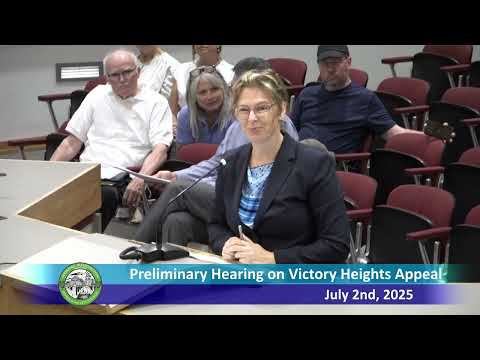
The ruling follows oral argument from attorneys for the applicant, Victory Heights Investments, and the city, and extended testimony from appellants Stefan Harvey and Steve Barrett, who live on and near Thorpe Road and argued the plat approval rested on incomplete traffic and infrastructure information.
The council’s action came after the parties filed preliminary motions and asked the council to decide whether the appeal could proceed. Timothy Fisher, assistant city attorney, told the council the motions seek dismissal on procedural grounds because the matters the appellants raise are “mainly about SEPA decisions” and “so intertwined with SEPA issues” that the council lacks jurisdiction to consider them anew. Duanna Koloshkova, attorney for applicant Victory Heights Investments, argued that the record and the hearing examiner’s mitigated determination and stipulated mitigation with the Washington State Department of Transportation (WSDOT) were adequate and that the appellants had not timely appealed SEPA matters to the hearing examiner.
In a nearly unanimous vote the council adopted the motion to dismiss. The motion cited Spokane municipal code provisions and the single-administrative-appeal rule for SEPA determinations. The council also ordered that further hearings on the matter be struck and asked counsel for the respondents to submit a proposed order to the city clerk.
Appellants Stefan Harvey and Steve Barrett told the council they are long-time residents near Thorpe Road and contend that a stipulation requiring a roundabout as mitigation — and the traffic patterns it would create — were not fully disclosed to affected stakeholders before the hearing examiner’s decision. Harvey said the stipulation and related materials described a roundabout that “will build a 3 legged roundabout at the easternmost access point for Victory Heights” and warned that the development and the stipulation’s measures could divert large volumes of traffic westbound on Thorpe Road. Harvey told the council the original traffic study “never anticipated a roundabout that would divert traffic … to the West,” and said that, because the stipulation was entered after the examiner’s March 19 hearing, affected agencies and citizens did not have full information at the time of the hearing.
Barrett, who identified himself as a resident and former real estate professional, described the neighborhood as long-established and said residents have a vested interest in reasonable access and safety on Thorpe Road. Both appellants urged the council to retain jurisdiction and review how the plat’s conditions align with the city’s comprehensive plan and capital facilities priorities.
City attorneys and the applicant’s counsel disputed those points. Fisher and Koloshkova said the mitigated determination of nonsignificance (MDNS) and the settlement with WSDOT track the mitigation discussed in the MDNS, that the MDNS expressly contemplated further traffic study and potential development-agreement terms, and that there is only a single administrative avenue to appeal a SEPA determination. Koloshkova told the council that final decisions about whether to restrict traffic directionality or to implement specific tunnel-related measures would remain a separate legislative decision for the council to consider, not a matter for relitigation of the SEPA MDNS.
After closed-session deliberations, the council president invited a motion. A council member moved to grant the respondents’ motion to dismiss on the grounds that the appellants’ assignments of error fall within the SEPA MDNS and that the council therefore lacks jurisdiction; the motion was seconded and passed with the members present voting in favor. The council directed respondents’ counsel to provide a proposed order to the city clerk and struck further hearings on the appeal.
The council did not reach the merits of appellants’ claims about traffic modeling, roundabout design, or the sufficiency of future mitigation funding. Council members and city attorneys noted the MDNS and the stipulation contemplate additional traffic studies and potential future legislative action before any change to Thorpe Road tunnel operations or a permanent closure of tunnel movements would occur.
The dismissal preserves the option for affected parties to pursue other review avenues where appropriate; city counsel noted that appeals of SEPA determinations, if timely filed to the hearing examiner and then to superior court where applicable, remain the procedural path for contesting MDNS findings. The council did not set a new hearing date or take additional action on the plat at the meeting’s conclusion.