Get Full Government Meeting Transcripts, Videos, & Alerts Forever!
Get email alerts on the Appellate Evidence topic
No spam. Unsubscribe anytime.
Massachusetts Appeals Court hears challenge over police testimony, "first complaint" evidence in Juvenile case
Summary
A three-justice panel heard oral argument July 2 in Commonwealth v. (Juvenile), case no. 24-P-89, focusing on whether a school resource officer's testimony about a later conversation and subsequent investigative steps violated the Massachusetts first-complaint doctrine and improperly limited cross-examination.
Boston ' The Massachusetts Appeals Court on Tuesday, July 2, 2025, heard oral argument in Commonwealth v. (Juvenile), No. 24-P-89, on whether testimony by a school resource officer about a November 2019 conversation and subsequent investigative steps was admissible under the state's first-complaint doctrine and whether the defense's cross-examination was improperly restricted.
The issue matters because testimony that conveys the fact of a later complaint can be prejudicial: counsel for the juvenile argued the detective's testimony telegraphed that a complaint had been made and improperly corroborated the complainant's account, while the prosecutor said the testimony was limited background and tied to text-message evidence used by both sides.
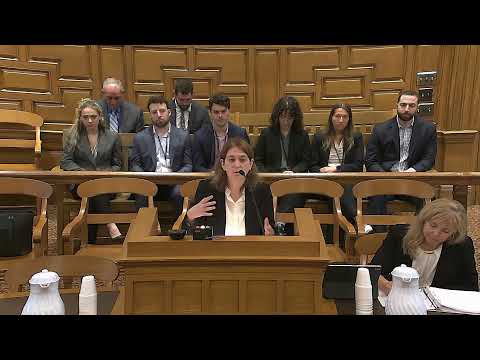
Attorney Michelle Mankin, representing the juvenile, told the panel she would "like to address the testimony of detective Isabelle, both the first complaint doctrine issues and the restriction on the right of cross examination." Mankin argued the officer's testimony described subsequent investigative steps'contacting the student's parents, meeting with the student and parents, writing a report, referring the report to another agency and collecting Snapchat and text messages'and that testimony "telegraphed the fact that a complaint was made in November 2019, which began the investigation." Mankin cited multiple SJC precedents by name in her briefing and at argument, saying such evidence "even without the details of the telling, violates the first complaint doctrine."
Assistant District Attorney Pamela Alford, for the Commonwealth, acknowledged the law disfavors some multiple-complaint testimony but said the officer's statements were about an investigation and the text messages the officer received were introduced in evidence. "This was a case where there were two theories about the delayed disclosure," Alford said. "The commonwealth theory was that the victim was manipulated by the juvenile. The juvenile theory was that she was fabricating this. And both theories relied on text messages." Alford added that some objections were not preserved at trial.
Defense counsel told the panel the complainant's timeline in testimony was uncertain: the alleged index incident could have occurred in March, April or May 2019; the first report occurred in June 2019; the November 2019 conversation with the detective came months later; and a formal complaint issued roughly two years after the incident. The complainant told the jury she did not see a SANE nurse until about a year-and-a-half after the alleged events, the defense noted. Mankin argued the detective's description of the student's demeanor (crying, looking down, wringing hands) was not a standalone permissible observation but part of the impermissible subsequent-complaint evidence.
Alford countered that the officer's testimony assisted the jury in understanding how the text-message evidence was gathered and that both parties had used text messages at trial to develop their theories. She also argued the officer was a school resource officer and that the testimony did not show an immediate, official mobilization of state resources (for example, DCF or a hospital response) of the kind this court has found especially prejudicial.
The attorneys also debated whether the defense preserved some of the constitutional and evidentiary objections below. The juvenile's lawyer said objections were raised contemporaneously when the detective began to testify about the November 2019 conversation; the Commonwealth said the record contained more general objections and argued specific claims were not preserved. The attorneys disputed the scope of permitted cross-examination and whether the trial judge's rulings prevented the defense from exploring alternate reasons the complainant might have been upset.
Mankin told the court there was "not an admission to this offense at all. There was an admission to a prior bad act," and said the only corroboration for the allegations at trial was the first complaint to a best friend and the detective's testimony. The Commonwealth noted the jury acquitted on an intimidation-of-a-witness count, which the defense said suggested the jury doubted some prosecution claims.
After questioning from the three-justice panel'Justice Joseph Ditkoff (presiding), Justice Sabida Singh and Justice Paul Smith'the court took the case under advisement. Justice Ditkoff closed argument by saying, "It was a very, difficult case, and we'll take it under advisement." The court adjourned; the justices invited interns to speak with them after the argument and scheduled the court to reconvene July 10.
The appeal centers on how the first-complaint doctrine and limits on cross-examination should be applied to testimony by a responding school resource officer who described a later conversation, subsequent investigative steps and the collection of electronic messages. The court heard argument but made no ruling at Tuesday's session.