Get Full Government Meeting Transcripts, Videos, & Alerts Forever!
Get email alerts on the Landfill Leachate Pfas topic
No spam. Unsubscribe anytime.
Committee moves forward with plan to address PFAS in landfill leachate; staff to pursue state funding
Summary
Facing potential cutoffs from wastewater plants, Marathon County committee approved starting planning for on-site leachate treatment — favoring reverse osmosis technology — and to pursue state clean water fund grants that could include principal forgiveness.
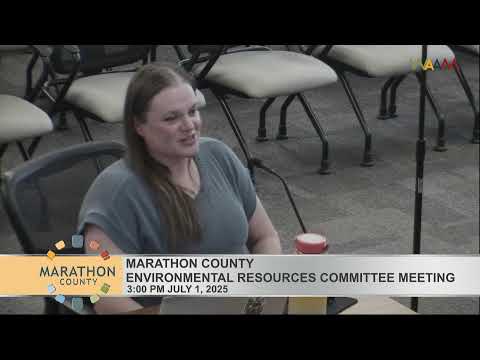
Marathon County's Environmental Resources Committee on July 1 approved moving forward with planning to treat landfill leachate on-site after solid waste staff warned that wastewater treatment plants increasingly are turning away leachate because of PFAS (per- and polyfluoroalkyl substances) concerns.
Director Dave Heggen (Solid Waste) told the committee that leachate — storm water and liquids concentrated with everyday municipal waste breakdown products — is being treated by regional wastewater plants today but that emerging contaminant regulations (PFAS) are restricting receiving facilities. Heggen said the department's facility plan identifies full on-site treatment using reverse osmosis as the best-value option, producing a concentrated residual stream that would be managed and a treated effluent that meets discharge requirements.
Heggen said Marathon County has submitted a draft application to the Wisconsin DNR's Clean Water Fund program, which is currently dedicating funding to projects addressing emerging contaminants; he noted potential eligibility for principal forgiveness of up to $3.5 million on projects that treat PFAS. The final application to DNR is due in late October (drafts due earlier), and county board adoption of the environmental management plan is required as part of the Clean Water Fund application package.
Supervisor de Wert moved to proceed with planning and gather additional information; Supervisor Unger seconded and the motion carried. Committee members discussed the longevity of PFAS (“forever chemicals”), suggested seeking joint-venture commitments with neighboring counties that may send leachate to a shared facility, and urged early outreach and partnership to share capital and operating risk.
Heggen said the department is sizing a plant for Marathon County's needs (approximately 50,000 gallons per day) with potential capacity to accept leachate from other counties such as Portage and Shawano. Committee members stressed early intergovernmental agreements to allocate capital costs, operating obligations and long-term responsibilities, because PFAS will remain in landfill leachate over the long term.
The committee's approval instructs staff to continue planning, finalize the Clean Water Fund application and return with more information about costs, funding options and potential partner agreements.