Get Full Government Meeting Transcripts, Videos, & Alerts Forever!
Get email alerts on the Rail Hazmat Response topic
No spam. Unsubscribe anytime.
BNSF details hazardous‑materials training, detection tools and response resources for Missoula responders
Summary
Peter Killman of BNSF told the Missoula County LEPC that the railroad runs about 1,600 trains a day, moves roughly 1.2 million hazmat shipments a year, and offers invitation‑only apps, online training and equipment caches to support local responders.
Peter Killman, BNSF hazardous materials and emergency response manager for Montana and Wyoming, told the Missoula County Local Emergency Planning Committee that BNSF operates roughly 1,600 trains a day and moves about 1,200,000 hazardous‑materials shipments annually and that the railroad maintains detection, training and response resources available to local responders.
Killman described tools meant to reduce incident risk and speed response, including positive train control (PTC) on locomotives, wayside and rolling‑stock detectors that generate large daily data reads, an invitation‑only AskRail app that lets verified first responders look up a railcar’s commodity and shipping papers, and an online learning center at bnsfhazmat.com with ethanol and other modules.
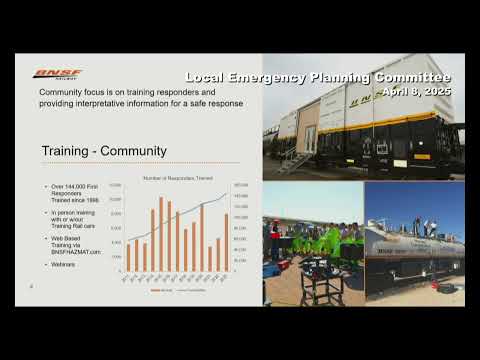
“All of these things are designed so if something bad happens we’re already connected,” Killman said. He emphasized community training and relationship building, saying, “I’d rather know you before bad things happen than get to know you at 03:00 in the morning when we have stuff on fire and bad things are happening.”
Killman gave specific resources: BNSF maintains equipment across Montana, including about 53 trailers and a wildland firefighting train made of four railcars that hold 30,000 gallons of water and a monitor on one end. He said the railroad has invested billions in track infrastructure and that detector systems and geotech “geocars” are used to find defects human inspectors might miss.
AskRail access is restricted for security reasons; Killman and a BNSF speaker described a Fort Worth desk that must approve high volumes of lookups to prevent misuse. Killman also said the railroad has trained about 150,000 first responders through its program.
The presentation concluded with an offer to host or coordinate local trainings and to answer questions from LEPC members and partner agencies.
Ending: LEPC members asked follow‑up questions about historical accident spikes and tank‑car standards; Killman noted several drivers, including historic volume changes and regulatory tank‑car phase‑outs, and encouraged agencies to request training and AskRail access through BNSF.