Get Full Government Meeting Transcripts, Videos, & Alerts Forever!
Get email alerts on the Emergency Declaration topic
No spam. Unsubscribe anytime.
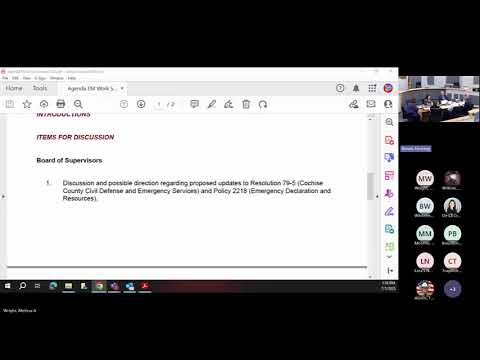
Cochise County supervisors review update to 1979 emergency-declaration resolution and 2020 policy
Summary
Cochise County supervisors and staff reviewed proposed updates to a 1979 emergency-declaration resolution and the county's 2020 emergency policy to align local rules with Arizona Revised Statutes Title 26 and federal emergency management guidance.
Cochise County supervisors and staff reviewed proposed updates to a 1979 county resolution and a 2020 internal policy that together govern how the county declares local emergencies and allocates emergency resources.
The proposed redraft, presented by Dan DeShawn, Cochise County emergency management director, updates statutory references to Arizona Revised Statutes Title 26 and federal guidance including the Robert T. Stafford Act and Homeland Security Presidential Policy Directives 5 and 8, replaces dated terminology such as "civil defense" with "emergency management," and aligns the county resolution's definitions and authorities with current state law.
The changes matter because the resolution sets the legal framework for when and how the Board of Supervisors or the chairman may declare and act during an emergency, and the accompanying policy governs internal resource allocation, mutual aid, and administrative actions during incidents that affect public health and safety.
DeShawn said the redline packet shows deletions in red and additions in blue and that the text largely mirrors current statutes. He explained the draft retains statutory definitions (for example, emergency functions, hazardous materials, and emergency management worker) and revises sections on the board's powers and the duties of the emergency management director to reflect current language.
Supervisors raised two recurring concerns during the discussion. First, several supervisors said they want a clear limit on unilateral authority by the chairman during an immediate incident. One supervisor asked that any emergency action taken by the chairman be validated or approved by the full board "within 24 hours or as soon as practicable." The group agreed staff should add a clause so the board can review and validate or rescind chair actions after an emergency response.
Second, supervisors asked that the resolution and policy make explicit how declarations are transmitted to the governor's office and state emergency management, and whether the county should include a formal request for state assistance. DeShawn said the draft does not yet include a transmission clause "but we could add that" and noted that a governor's declaration sometimes is required for federal public assistance; he said that when the governor declares and federal assistance is later approved, the county may be reimbursed for eligible costs (the presentation cited the standard public assistance model in which the governor's declaration can make counties eligible for partial reimbursement of disaster-related expenses).
On operational details, DeShawn described the policy provisions that differentiate actions taken prior to a formal declaration (when departments can reassign personnel to protect life and property) and actions taken during a declared local or state emergency (which can include suspending paid time off, reallocating equipment, and using special revenue or contingency funds subject to later appropriation by the board). He said the emergency manager coordinates resource requests through the county administrator and maintains inventories of public and private organizations, facilities, equipment and supplies available to respond.
Supervisors also discussed practical cross-jurisdictional issues: county declarations in unincorporated areas versus city declarations inside municipal limits, existing intergovernmental agreements and mutual-aid arrangements with local fire departments, and how 911/CCOM dispatch would route a large-scale incident to county emergency management. DeShawn noted that state statute governs several of those boundaries and that the county's resolution cannot expand beyond statutory limits, though the board can elect to impose tighter local limits on its own authority.
No formal motion or vote was taken during the work session. Supervisors and staff agreed to further edits and to return the revised resolution and policy for board consideration in roughly three weeks; staff indicated an August board meeting was a likely target to bring a revised draft back for action.
The discussion closed with supervisors asking staff to (1) add explicit language requiring board validation of chairman actions within a specified short timeframe, (2) add a procedure to transmit declarations and requests for assistance to the governor's office and state emergency management, and (3) clarify the chain of command for resource requests, mutual aid, and use of special revenue or contingency funds during emergencies.