Get Full Government Meeting Transcripts, Videos, & Alerts Forever!
Get email alerts on the Land Use Zoning topic
No spam. Unsubscribe anytime.
Cochise County OKs zoning change to allow larger accessory structures, targeted to antiquated subdivisions
Summary
The Board of Supervisors adopted a text amendment to the county zoning regulations allowing accessory structures to be built before—and to be larger than—principal residences in select antiquated subdivisions such as SunSites; the change applies only to parcels of four acres or more and includes site-development limits.
The Cochise County Board of Supervisors voted 3-0 on July 1 to adopt a zoning text amendment that permits accessory structures to be built before a principal residence and for those accessory structures to be larger than the principal residence in specified antiquated subdivisions, including SunSites.
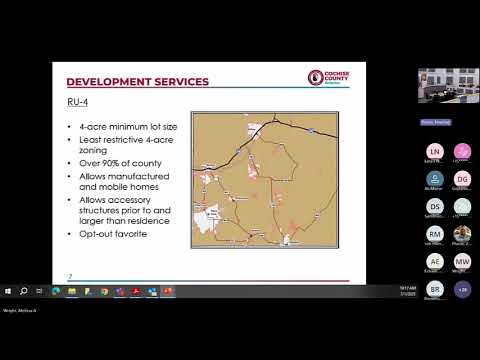
County planner Michael Taylor presented the docket, R-25-01, explaining the change was intended to give property owners in older, largely undeveloped subdivisions more flexibility without switching their zoning to RU-4, which permits manufactured housing. Taylor said SR-174 standards (minimum lot size of four acres) would be modified for only those antiquated subdivisions and would mirror RU-4 in allowing accessory structures prior to a principal structure and permitting accessory structures larger than the eventual home, subject to existing site-development standards.
The amendment was driven in part by repeated disputes over owner-builder opt-out requests in SunSites, a 1960s subdivision with roughly 1,400 parcels and many tax-lien and undeveloped lots. Taylor told the board about maps showing that only about 4% of those parcels had single-family residential development and that roughly 20% had tax liens. The Planning and Zoning Commission reviewed the amendment as a work session and recommended the narrow option—apply changes only to antiquated subdivisions—by a 7-0 vote at a public hearing in May, Taylor said.
Supervisors asked staff several procedural and substantive questions. Board members clarified the amendment applies only to designated antiquated subdivisions, not countywide; that SR-174 applies to parcels of four acres or more; and that the longstanding ban on mobile homes would remain in place on SR-174 parcels. Staff said site development standards—height limits (30 feet), setbacks and other controls—still apply, so the amendment is not a carte blanche for arbitrary large accessory structures. Taylor and staff also said most opt-out applicants provide both principal and accessory structure plans up front and that permitting remains an administrative process unless a site-development standard is not met, in which case the matter could move to quasi-judicial review by the board of adjustment.
Supervisor Tom Crosby said the amendment “goes a long way” toward resolving conflicts in those subdivisions but acknowledged the board could revisit the rules if needed. Other supervisors urged future review of agricultural and RU-40 interactions for prospective buyers who may find themselves adjacent to working ranches.
The board approved the amendment as amended; the adopted text establishes overlays and amended SR accessory-use standards for qualifying parcels, sets an assurance/implementation timeframe in the replacement language, and keeps development controls in place. The motion passed 3-0.
The change is limited in scope to preserve the county’s broader zoning framework while offering a regulatory path for owners in older subdivisions to develop larger accessory buildings (barns, workshops, storage) ahead of constructing a principal residence, subject to permitting and site standards.