Get Full Government Meeting Transcripts, Videos, & Alerts Forever!
Get email alerts on the Demolition Storm Damage topic
No spam. Unsubscribe anytime.
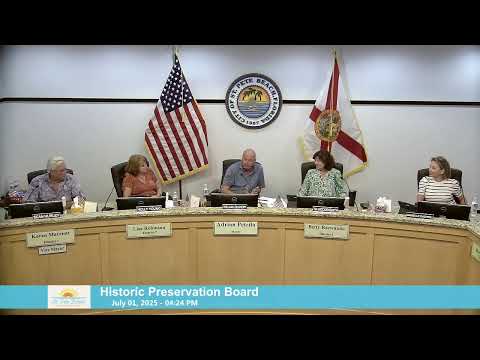
Historic Preservation Board clears demolitions for multiple storm‑damaged homes in Pass‑a‑Grille
Summary
The board approved certificates of appropriateness to demolish four storm‑damaged single‑family properties in Pass‑a‑Grille (cases 25073, 25079, 25078 and 25072), voting in each case to allow demolition without invoking the 30‑day stay that can delay demolition while preservation options are explored.
The Historic Preservation Board approved certificates of appropriateness permitting demolition without a stay for four single‑family residences extensively damaged in recent storms: 113 Third Avenue (case 25073), 206 Pass‑a‑Grille Way (case 25079), 1209 Pass‑a‑Grille Way (case 25078) and 2604 Pass‑a‑Grille Way (case 25072).
City staff summarized each property’s condition and damage assessments. For 113 Third Avenue, staff displayed pre‑storm survey photos and post‑storm images and reported substantial interior damage; Roger (building official) said he had inspected the property and found the interior largely destroyed, though the exterior had stayed together. The property owners told staff they had considered historic designation and rehabilitation but chose demolition.
For 206 Pass‑a‑Grille Way, the board heard from Roger that the house had been pushed off its support blocks and sustained structural failure to the front; staff recommended demolition without a stay. The applicant’s agent discussed the property’s damage and the practical challenges of rehabilitation.
The 1209 Pass‑a‑Grille Way property was declared 100% substantially damaged by the city’s consultant; the applicant was not present but had indicated demolition as the preferred path. Staff noted the lot size can support replacement development, subject to overlay requirements.
At 2604 Pass‑a‑Grille Way, staff’s consultant estimated approximately 85% damage to the primary structure; the property also contained a detached garage that had been identified as a contributing outbuilding. Staff recommended allowing demolition without a stay; board members discussed the historic‑outbuilding status and whether the owners had explored rehabilitation or listing as historic, and staff said the owners had considered options but chose demolition.
Board members repeatedly asked whether owners had been offered or considered alternative approaches such as moving intact historic‑shell houses at other locations to replace destroyed structures. Staff said owners had explored designation and rehab in several cases; some owners declined and requested demolition.
For each case, a motion to approve demolition without a 30‑day stay was made, seconded and passed by roll call. Recorded votes show unanimous board approval in each case.
Board members noted pending overlay amendments and reminded applicants that future redevelopment must comply with overlay design standards when those amendments take effect.