Get Full Government Meeting Transcripts, Videos, & Alerts Forever!
Get email alerts on the Historic Preservation Plan topic
No spam. Unsubscribe anytime.
Historic Commission reviews revised preservation plan, requests local examples and signage guidance
Summary
The Middletown City Historic Commission on June 19 heard a presentation from consultant Liz Fields of McBride Bridal Clarion on a revised draft Historic Preservation and Revitalization Plan and offered detailed edits and policy-focused feedback.
The Middletown City Historic Commission on June 19 heard a presentation from consultant Liz Fields of McBride Bridal Clarion on a revised draft Historic Preservation and Revitalization Plan and offered detailed edits and policy-focused feedback.
"It's been quite the journey, but we're glad that we're getting close to the end," Liz Fields said as she summarized structural edits and new material in the draft, including a reorganized introduction, a clearer description of the certificate of appropriateness (COA) process, an expanded section on national and local designation, and a new implementation table. "We got a nice draft document, but we're always open to comments," she added.
Commissioners pressed for both editorial and substantive changes. Commissioner Roger Daniel asked for a more professional introductory paragraph with a separate callout box to summarize key points for casual readers, saying the plan should avoid requiring readers to "go fetch from the Internet" for central standards. Commissioner Gabe Scheinlein and other commissioners recommended the plan explicitly note historic assets already lost and include local "before-and-after" preservation wins to balance the account of loss with success stories.
Fields told the commission the draft now includes an expanded chapter on the National Register process, a comparison of national and local landmark designations, clearer descriptions of Middletown's historic districts and landmarks, and revised design guidelines that reference the Secretary of the Interior's standards. "We have kind of a specific chapter about the national register process," she said, and added the rehabilitation standards are included with links to other standards.
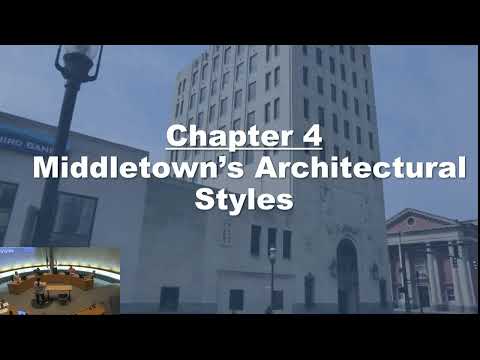
Commissioners requested more locally sourced photographs and precise addresses for the plan's architectural-style examples. Members identified at least one incorrect photo-caption pairing: the Francis Titus House image and address do not match. Fields said staff can supply addresses and local photos and that the consultant will swap in local examples where possible.
Signage and commercial character drew sustained discussion. Planning staff (Claire) and commissioners discussed placing clearer guidance on permanent versus temporary signage, illumination, murals and bench ads in commercial historic districts. Fields said the consultant team can provide recommended language and example images to guide staff and applicants, while noting zoning cannot regulate sign content. Commissioner Anthony Rossi suggested guidance distinguishing where commercial-style signage is appropriate as districts transition into neighborhoods.
Commissioners also debated scope: several members recommended the plan include language recognizing threats from large-format retail and proposals to promote locally owned businesses (storefront improvement grants, business incubators) even if zoning or the development code ultimately governs the tools. Fields said an upcoming development-code update contract may allow better alignment between zoning and the preservation goals.
The commission received an update on a separate structural and environmental assessment. Luis (Chief Building Official) said engineers and architects from Burgess and Neiple toured multiple downtown buildings—including the Manchester, the Snyder, First National Bank, and the Knights of Columbus Hall/Vail House—and that the consultant team was still preparing a written report. "They gave me a timeline of about a month," Luis said; he added the team had taken material samples and that the report was taking longer than normal.
Commission members and at least one public commenter representing Save Downtown Middletown urged a clear, detailed financial feasibility analysis comparing rehabilitation, security/maintenance, and demolition costs before any demolition decisions are made. Fields and staff said developers have toured buildings and that feasibility input from developers plus the Burgess and Neiple report will inform next steps; Fields and staff reiterated all options remain on the table.
The commission approved the meeting minutes by voice vote earlier in the session and later moved to adjourn. Staff said required training will be held at the next meeting because membership is reduced and several commissioners plan to attend.
Next steps outlined by consultant and staff: incorporate commissioners' copy edits and local photo substitutions, add clearer COA and district‑expansion procedures, provide recommended signage language and example imagery, and await the Burgess and Neiple written assessment (estimated about one month) to inform any feasibility work or formal recommendations to city council.