Get Full Government Meeting Transcripts, Videos, & Alerts Forever!
Get email alerts on the Zero Waste Education topic
No spam. Unsubscribe anytime.
Home Resource expands zero-waste education for Missoula fifth-graders
Summary
Kate, education and outreach coordinator at Home Resource, outlined the organization’s Zero Waste Ambassadors Program (ZWAP), a standards‑aligned education program for fifth graders that combines a classroom visit, a visioning activity and a two‑hour field trip to Home Resource.
Kate, education and outreach coordinator at Home Resource, outlined the organization’s Zero Waste Ambassadors Program (ZWAP), a standards‑aligned education program for fifth graders that combines a classroom visit, a visioning activity and a two‑hour field trip to Home Resource.
ZWAP’s classroom visit is roughly one hour and introduces students to the materials economy and the circular economy, Kate said. The lesson frames choices at home and school — reduce, reuse, rot (compost) and recycle — and links those choices to local consequences such as wildfire smoke and drought. “ZWAP itself is a standards aligned program for fifth grade students,” Kate said.
The program runs in three parts. First, the classroom presentation introduces systems thinking about how products are made, moved and disposed. Second, students complete a visioning activity — examples include drawing self‑portraits as zero‑waste ambassadors, writing letters to companies (one student wrote a letter to Culligan about single‑use water jugs) or redesigning items destined for the landfill. Third, students visit Home Resource for a roughly two‑hour field trip that includes a board game simulation of the circular economy, a tour of the donation store and a hands‑on building project using donated materials.
Kate said the program is now in its tenth year and that ZWAP served about 900 students across 41 classrooms in 17 schools during the 2024–25 school year. Bonner and Lolo schools participated for the first time or after a break, adding roughly 90 students to the program this year.
During field trips small groups are assigned a building project (examples Kate cited: a treehouse, a chicken coop, a bathroom) and shop the donation store to find donated materials. Kate said typical group projects use an estimated 3,000 to 4,000 pounds of donated material, a figure the class uses to illustrate how reuse keeps resources out of landfills. Students also play a classroom game that asks them to choose where items go — landfill, reuse, donation or back to a factory — and then rank those choices by environmental consequence.
Funding and partnerships: Kate said schools do not pay to participate; ZWAP is free to schools and is supported by grants, donations and a partnership with the city of Missoula. She also said Home Resource coordinates summer activities (for example, nature‑based builds with visiting groups) and partners with local groups such as Garden City Harvest and MNHC for seasonal programming. Caitlin at Home Resource led a “Zero Waste Action Month” effort that included a thrift‑store map of Missoula, Kate said.
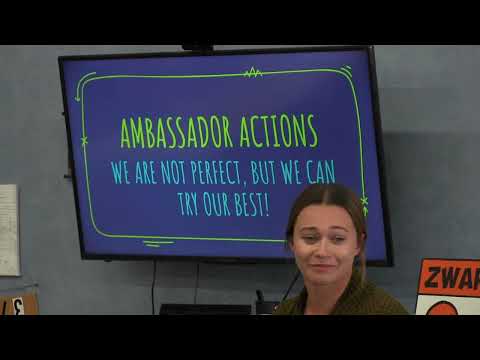
Instructional goals and takeaways: ZWAP asks students to serve as ambassadors who “lead by example and encourage others,” Kate said, but she emphasized that students are not expected to be perfect; the curriculum stresses incremental actions appropriate to students’ living situations (for example, not every student has access to curbside composting). The program uses local examples — including a recent July windstorm and visible litter — to help students connect systems learning to community impacts.
Participants asked about outreach and scaling. Attendees suggested ideas such as a citywide event to bring classes together, competitions or school‑level challenges, partnerships with university climate programs and volunteer fix‑it clinics or sewing demos to build repair skills. Kate said Home Resource currently shares student visioning work across classrooms but does not yet run a single event that unites all participating classes.
Program materials and classroom activities noted in the presentation include: a game board for the circular economy, waste‑tracking worksheets (Kate cited an estimate that Montanans throw away about 8 pounds per person per day), redesign exercises (for example, compostable ketchup bottles, multipurpose coat hangers) and letter writing to manufacturers. Home Resource also allows students to sign a ZWAP wall to commit to continuing ambassador actions after the visit.
Why it matters: Program leaders say early, standards‑aligned exposure to systems thinking and reuse can influence long‑term behavior and support city goals referenced in Missoula’s 0 by 50 planning (Kate referenced Path C of that plan). The program also models a local circular‑economy pipeline — donation, reuse and project‑based construction — that keeps materials in community use rather than in landfills.
What’s next: Kate invited attendees to sign the ZWAP wall and encouraged community volunteers for fix‑it clinics and sewing or repair instruction. She said Home Resource will continue school outreach and summer programming, and is exploring ways to connect participating classes across the district.