Get Full Government Meeting Transcripts, Videos, & Alerts Forever!
Get email alerts on the Downtown Business Improvement District topic
No spam. Unsubscribe anytime.
Committee advances expansion of downtown business improvement district amid oversight and enforcement questions
Summary
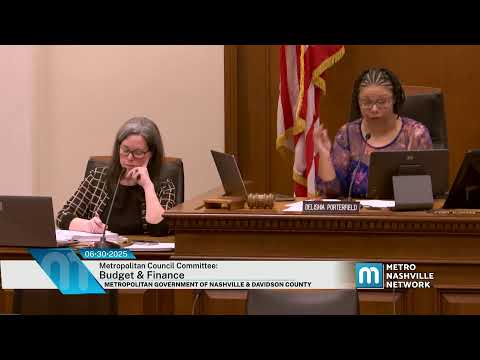
The Metro Nashville Budget & Finance Committee on June 30 approved second reading of an ordinance to expand a downtown Central Business Improvement District (CBID), adopting an amendment that adds reporting requirements and re-referring the measure to committee for further review; the vote was 10-0.
The Metro Nashville Budget & Finance Committee on June 30 approved second reading of an ordinance to expand a downtown Central Business Improvement District (CBID), adopting an amendment that adds quarterly reporting and ordering a re-referral to the committee for additional review; the motion passed 10-0.
Supporters of the CBID expansion told the committee the district helps keep downtown “clean and safe.” Brenda Sanderson, a downtown business owner and resident of District 19, said, “I do not wanna go back to that, especially considering our current status as a first class city.” Tom Turner, president and CEO of the Downtown Partnership, said the organization sends monthly accounting reports to NDOT and that an independent audit is delivered annually: "Monthly, we send an accounting report to what is now NDOT... and then at the end of the year, within 90 days of the end of the year, there's an audit that is sent."
Why this matters: the expansion is projected to generate about $8,000,000 for downtown services that supporters say fund cleaning, safety ambassadors and other services that affect downtown residents, businesses and visitors. Several council members said the committee needs clearer, consistent financial reporting directly to Metro Council, not only to Metro Finance, so the council can exercise the review and approval duties described in the Metro Code.
Committee members questioned whether existing reporting met the Metro Code requirement that the district’s annual budget "shall be reviewed and approved by the Metropolitan Council." Director Darby said annual financial statements and budgets have been submitted to the finance department; Council member Parker said he could not find council records showing those budgets had been reviewed and approved as the code requires and called the omission "a serious issue." Turner said the Downtown Partnership submits monthly reports by the 25th of each month and provides an annual audit prepared by Cherry Bekaert.
Members also pressed the sponsor about enforcement and public-safety staffing. Several council members raised the CBID’s use of off-duty Tennessee Highway Patrol personnel for downtown enforcement and asked how arrests and outreach would be documented and how that work aligns with Metro Police Department policies. Council member Parker said he was "not comfortable with that approach to policing and homelessness;" other members said additional information on arrests and the use of THP officers is being collected before the bill’s third reading.
On governance, committee members discussed board composition. The ordinance would increase the district management corporation's board to a minimum of 15 and a maximum of 20 members, with pro rata seats for other downtown district stakeholders; the Downtown Partnership would have an operating board that council members recommended as the pragmatic place to add neighborhood representation.
The motion approved in committee combined Council member Kupping’s reporting amendment with a direction that the mayor's office and relevant departments provide additional documentation and that the bill be re-referred to Budget & Finance for follow-up before third reading. The committee then approved second reading of the ordinance, as amended, by a 10-0 vote.
Looking ahead: the ordinance is amendable on third reading and will have a public hearing on July 15. Committee members said they want more granular data on parking-lease revenue sharing, the full audited financials, and arrest statistics tied to downtown enforcement before taking final action.