Get Full Government Meeting Transcripts, Videos, & Alerts Forever!
Get email alerts on the Federal Grant Transition Ta Center topic
No spam. Unsubscribe anytime.
Education Department holds pre‑application webinar for national transition technical‑assistance center; applications due July 18
Summary
The U.S. Department of Education’s Office of Special Education Programs held a pre‑application webinar outlining a discretionary grant competition to establish a National Technical Assistance Center on Transition for Students and Youth with Disabilities (Assistance Listing 84326E).
The U.S. Department of Education’s Office of Special Education Programs held a pre‑application webinar outlining a discretionary grant competition to establish a National Technical Assistance Center on Transition for Students and Youth with Disabilities (Assistance Listing 84326E). The notice inviting applications was published in the Federal Register on June 18, 2025, and applications are due no later than 11:59 p.m. Eastern on July 18, 2025.
The webinar summarized the program purpose, eligibility, funding limits, application requirements and submission process. The competition will fund a cooperative agreement to operate a National Technical Assistance Center to assist state education agencies (SEAs), local education agencies (LEAs), state vocational rehabilitation (VR) agencies and other service providers in improving secondary‑to‑postsecondary transition services for students and youth with disabilities.
The grant carries a maximum award of $4,099,988 per year for up to 60 months and uses an unrestricted indirect cost rate; the indirect rate for Rehabilitation Services Administration (RSA) funds is 10 percent. The notice requires applicants to budget for a 5 percent set‑aside as described in the NIA and to include funds for attendance at in‑person kickoff and project director meetings and for department briefings.
Eligible applicants listed in the webinar include public or nonprofit agencies or organizations, Indian tribes or tribal organizations, for‑profit organizations, SEAs, state VR agencies, LEAs (including public charter schools that are LEAs under state law), institutions of higher education and community rehabilitation programs. The webinar also explained that grantees may award subgrants consistent with 34 C.F.R. § 75.708(b) and (c) to IHEs, nonprofit organizations and public agencies identified in an approved application or selected through procedures established by the grantee.
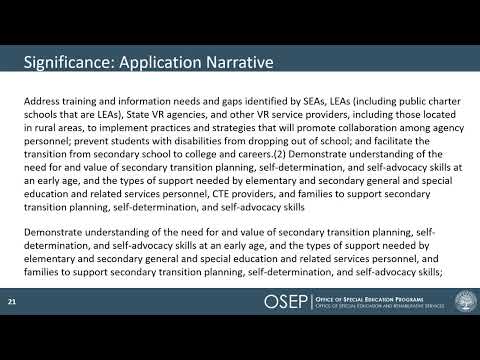
The presentation detailed selection criteria and scoring: significance (10 points); quality of project design (35 points); quality of project evaluation (20 points); adequacy of resources (10 points); and quality of the management plan (25 points). Applicants must submit a project logic model, describe how proposed activities are informed by research or evaluation (the NIA’s definition of evidence‑based), and include a third‑party evaluator who has not participated in project development or implementation.
The webinar emphasized expected outcomes, including increased SEA and VR agency capacity to collect valid data used for decision‑making (for example, graduation and dropout rates, IDEA indicators, and post‑school outcomes), improved delivery of professional development and technical assistance to LEAs, and strengthened collaboration among education, VR and workforce partners to expand career pathways and competitive integrated employment for students and youth with disabilities.
On submission logistics, the presenter said, “Applications must be submitted electronically using grants.gov.” The webinar warned that grants.gov registration can take five or more business days and that applicants should verify successful submission and validation; applications may not be submitted by email and late or duplicate applications are ineligible.
For additional questions, the webinar listed OSEP contact David Guardino (OSEP contact) at david.guardino@ed.gov and RSA contact Tara Jordan at tara.jordan@ed.gov. The webinar closed with the presenter saying, “This concludes our webinar. Thank you for your interest and attention.”