Get Full Government Meeting Transcripts, Videos, & Alerts Forever!
Get email alerts on the Board Governance topic
No spam. Unsubscribe anytime.
Board begins governance overhaul: norms, communications, goals and a school 'roadshow' on the agenda
Summary
In a lengthy work session the Newberg School District board explored team norms, communication protocols, draft board agreements, priority-setting and a plan to hold meetings in district schools as part of strategic planning and community engagement.
The Newberg School District Board of Directors spent the second half of its July 1 meeting in a work session focused on governance: defining team norms, improving communications, drafting board agreements for conduct and escalation, and aligning on board and superintendent goals and timeline for strategic planning.
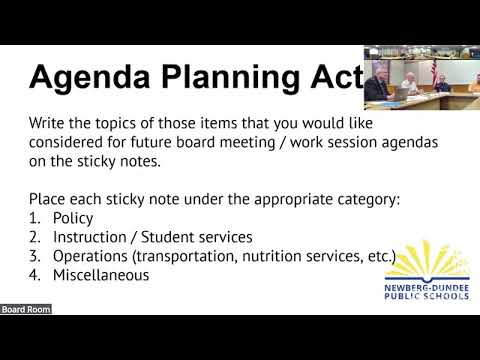
Facilitated by the superintendent, the session opened with an exercise intended to surface the board’s purpose and the public value of education. Board members posted and read sticky-note responses identifying common themes: safety, community, lifelong learning, college- and career-readiness, critical thinking, and support services for students in need. Members said those themes should guide the board’s priorities and goals for the coming year.
The superintendent presented draft board agreements (several sample templates provided by the Oregon School Boards Association and a more detailed draft prepared for the board) and a proposed escalation path if a board member violates agreed norms. The suggested sequence included private conversation by board leadership, small-group dialogue, reaffirmation of agreements in a public meeting and — as a last resort — censure steps consistent with board policy and public process. Board members asked for additional time to review the draft, requested a focused work session on the agreement language, and asked staff to bring a one-page summary for a first read at a future meeting.
Communication was a central theme. Board members asked for clearer, regular updates from the superintendent and staff outside of formal meetings, expressed a desire for scheduled one-on-one or small-group check-ins with the superintendent, and asked staff to centralize board materials in a shared digital location (the superintendent discussed board-management software such as BoardBook and the district’s ability to provide Chromebooks or district devices for packet access). Staff agreed to add board directors to each school’s communications distribution lists so directors receive school newsletters and event calendars via district email accounts.
The board also reviewed an initial framework for shared board–superintendent goals and timelines. The superintendent proposed aligning board goals with superintendent goals so that the district’s cabinet and staff have coherent objectives cascading to classroom and program levels. Suggested goal areas included public communications and visibility, strategic planning and community engagement, long-term financial stability, and instructional focus that supports student achievement. The superintendent said he would draft measurable objectives (OKR-style objectives and key results) and return with a proposed timeline; board members asked for public input and suggested the district use a ThoughtExchange and meetings to gather community feedback, aiming to finalize priorities in late summer or early fall and to begin formal strategic-planning work by January.
Board members also discussed a proposal to hold some board meetings and work sessions in district school buildings as part of a "roadshow" approach to public engagement. The idea is to combine a regular business meeting with earlier, school-hosted activities (student performances, displays of student work, parent group engagement) so the board can be visible in different communities and hear school-specific context from administrators, staff and local parents. Members asked staff to develop a plan that minimizes burden on schools and maximizes community participation.
Ending: The board asked the superintendent to refine the draft board agreements, prepare a one-page summary for the next meeting, develop a calendar for the school-location meetings, and draft measurable OKR-style goals for the superintendent and board to review in August.
Provenance: The governance discussion and exercises — why public education matters, team norms, board agreements, communication protocols, goal-setting and the school-meeting plan — are recorded in the transcript’s work-session section and ran late into the evening.