
Royal Oak Schools board approves June budget amendments, hears $4.8 million gap in 2025-26 original budget
Get AI-powered insights, summaries, and transcripts
Subscribe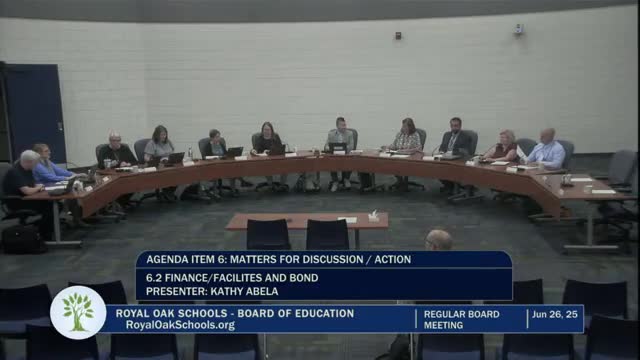
Summary
At its June 25 meeting the Royal Oak Schools Board of Education approved final amendments to 2024-25 budgets and the districtapproved the 2025-26 preliminary budgets after hearing staff say the district faces a structural deficit tied to state funding assumptions and contract costs.
Royal Oak Schools Board of Education on June 25 approved final amendments to the district—s 2024-25 budgets and adopted preliminary budgets for 2025-26 after staff outlined assumptions that produce an estimated $4.8 million structural deficit for the coming fiscal year.
In a presentation to the board, Ms. Abella, district finance staff, said the 2025-26 original budget was prepared using a $400-per-pupil increase in the foundation allowance and other assumptions. "At the bottom of my actual budget, we used the $400 per pupil," she said.
The budget presentation summarized three actions before the board: (1) final amendments for 2024-25 for the general, community service, food service and student activity funds; (2) projections for ancillary funds (debt service, property maintenance, sinking fund, technology); and (3) adoption of the 2025-26 original budgets. The board approved the three resolutions by voice vote.
Why it matters: district staff said the 2025-26 original budget reflects a combination of rising contract costs, reductions in some categorical state funding, and the near-term end of federal COVID-related grants that the district used in prior years. Staff warned the funding picture from Lansing remained unsettled and that final audited fund balances and any late state action could change the district—s position.
Key numbers and assumptions provided by staff during the meeting: - The district used a $400 per-pupil foundation allowance increase as the working assumption for the original 2025-26 budget. - The presentation grouped known cost increases and adjustments that, together with prior structural items, produced about a $4.2 million to $4.8 million structural gap for the 2025-26 original budget depending on which legislative scenario is realized. - The board was presented a projected starting fund equity for 2025-26 of about $9.9 million (about 11% of operating, per staff's on-screen calculation). - For the 2024-25 final amendment, staff said the structural deficit was approximately $1.9 million after including some late items and levy receipts; auditors will finalize the 2024-25 audited fund balance in September. - Staffing assumptions included a reduction of roughly 11.3 full-time-equivalent positions in the coming year (reflected as efficiencies in scheduling and class sizes) and collective bargaining cost increases that staff included as assumptions in the budget.
Staff explained contingencies the board should watch: - House Bill 6058 (referred to by staff by bill number) could change the district—s PA 152/health insurance assumptions; the final amendment included a 3.5% placeholder in case that change occurs. - Several categorical and retirement-rate changes (discussed in the presentation with references to ORS/PA 152-related line items) have moved between proposals from the governor, the House and the Senate, producing uncertainty in the net funding the district will receive. - Food service participation and state policy on universal free meals (state funding for universal free breakfast and lunch) remain an unknown and could materially change revenue and participation in the food service fund.
Staff walked the board through fund-level details: - Community service fund (which houses early childhood programming and the Churchill program) showed a projected deficit of about $955,000 for the current year and $809,000 for 2025-26; staff said expansion of GSRP (Great Start Readiness Program) and tuition adjustments for preschool help narrow that gap. - Food service fund showed a current-year structural deficit of about $560,000 driven in part by capital projects (new loading dock at Royal Oak High School and equipment) and by assumptions about ongoing state support for universal meals. - Student activity funds were presented as pass-through activity accounts with projected revenue and expenditures of roughly $1.5 million and a current fund balance of about $815,000; staff emphasized these are activity-specific dollars, not available to the general fund. - Ancillary funds discussed included the debt service fund (levy proceeds to pay bond debt), a 2022 sinking fund (expected to generate ~ $4.0 million annually from the levy) and technology and property maintenance funds. Staff noted sinking-fund proceeds are restricted to capital-eligible items (roofs, parking lots, instructional technology) and cannot be spent on salaries or benefits.
Board members asked questions about timelines and next steps. Ms. Abella and other staff said the district typically completes its first amendment in December, after enrollment counts and audited figures are more settled, and that auditors will present final audited 2024-25 results in September. "We usually do our first amendment in December of each year," staff said.
Action taken: the board voted to approve the presented 2024-25 budget amendments and the proposed 2025-26 original budgets for the funds legally required (general, community service, food service, student activity) and separately approved projections for the ancillary funds. The motions passed by voice vote; no roll-call tallies were recorded in the public portion of the transcript.
What the board directed / next steps: staff said they will continue to monitor state budget developments, track actual enrollment when students arrive in the fall, reconcile final 2024-25 audit numbers in July and present amendments as needed (typically December) if major legislative changes or enrollment shifts occur.
Ending: staff noted that while the district is projecting a structural gap, prior use of one-time grant dollars and careful planning reduced the need for deeper program cuts this year. Auditors will finalize the 2024-25 audited fund balance in September; the board may revisit budgets through amendments if state action or enrollment figures change.