
Anchor Bay board authorizes up to $11 million energy bond, approves SentriX contract
Get AI-powered insights, summaries, and transcripts
Subscribe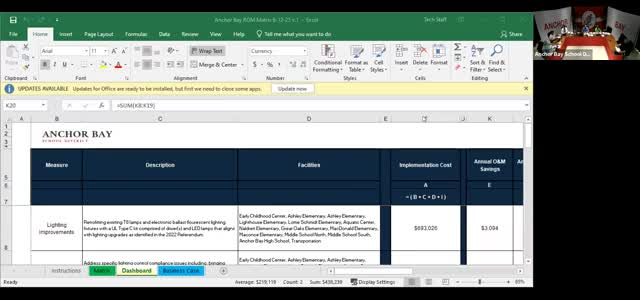
Summary
The Anchor Bay School District board voted to approve a not-to-exceed $11 million energy bond and to contract SentriX (Centrix/SentriX) to carry out energy-efficiency projects that officials said will be paid for largely by guaranteed utility savings.
The Anchor Bay School District Board of Education on June 25 approved a resolution to authorize energy bonds not to exceed $11 million and separately awarded a construction contract to SentriX to implement energy-efficiency projects across the district.
District finance staff and SentriX representatives told the board the projects — new lighting, boilers, chillers, kitchen metering, controls, pumps and other measures — are projected to cost about $12.2 million, of which roughly $6.1 million would be financed with the energy bond and about $5.8 million would be paid from bond proceeds already approved by voters. Todd Rathbun, presenting the plan, said the district expects about $438,000–$444,000 in combined annual utility and operation-and-maintenance savings and that those savings would cover annual debt service on the financed portion. “If we come to this and we say $438,000 is guaranteed to the district in savings ... if they only generate $300,000 worth of savings, they have to write us a check for the difference,” Ron Stimick of SentriX said.
Administrators said the district will bid individual projects and bring detailed scopes back to the board for approval before work begins. They also said some work included in the 2022 voter-approved bond could be paid for with energy-bond proceeds, freeing bond dollars to cover other promised projects and to hedge against inflation-driven cost increases.
Board members asked how the plan affects already-negotiated energy supply rates. Rathbun said the district has a capped energy supply contract with SEMCO that locks rates at 7.5 cents per kilowatt-hour for roughly 15 years; that cap reduces the projected utility escalation and somewhat weakens the business case but does not eliminate projected savings. SentriX representatives said the firm will guarantee measured savings and backfill any shortfall.
The board passed the energy resolution on a roll call vote (Knox: yes; Sunnyberger: yes; Powers: no; Venatelli: yes; Richards: no; Green: yes). The board then approved the SentriX contract (same roll-call pattern). Administrators said projects will be bid and presented to the board for individual approval and that measurement-and-verification clauses and a savings guarantee are included in SentriX’s approach.
The energy program is planned as a 20-year financing; presenters estimated the combined useful life of the installed equipment exceeds the financing term and projected a full payback in roughly 13–14 years, with additional net savings thereafter.
Administrators said some work — such as separate metering of kitchen utilities that allows charging those costs to the food-service fund — will reduce the general fund’s utility burden. They also noted the plan will let the district accelerate work to avoid future inflation increases on items such as boilers and structural steel.
The SentriX contract award and the resolution will let the district proceed to detailed bids and bring each scope back to the board for approval.