Get Full Government Meeting Transcripts, Videos, & Alerts Forever!
Get email alerts on the Unified Development Code topic
No spam. Unsubscribe anytime.
Woodland Park planning commission previews draft Unified Development Code, sets review deadlines
Summary
At a June 26 workshop, Woodland Park planning staff and a consultant reviewed a near-final draft of a Unified Development Code that would consolidate the city’s land-use rules into seven chapters; commissioners were asked to submit substantive comments by July 7 and to attend a July 10 work session to discuss major issues.
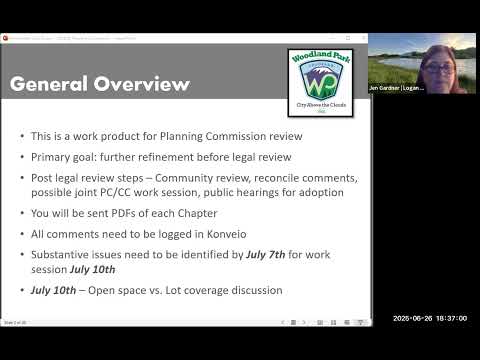
WOODLAND PARK, Colo. — Woodland Park planning staff and their consultant on Thursday walked the Planning Commission through a near-final draft of a Unified Development Code, asking commissioners to focus on substantive edits and to log comments in the Conveio review platform ahead of a July 10 work session.
The draft, which staff said they will deliver to commissioners as seven searchable PDF chapters, reorganizes and consolidates the city’s land-use rules into a single UDC intended to replace multiple existing titles. Staff described the document as a “work product for review” that will go to the city attorney for legal review before any public unveiling and formal adoption process that starts with a Planning Commission public hearing and moves to City Council for final approval.
Why it matters: The UDC would centralize procedures and standards now scattered across multiple chapters, change how some uses and parking requirements are presented, and clarify subdivision and parkland-dedication rules that staff described as historically confusing. Because the code governs zoning, permitted uses, development standards, subdivision requirements and administrative procedures, the rewrite affects developers, property owners and neighborhood expectations about land use in Woodland Park.
What staff proposed and commissioners discussed — most important points first:
- Structure and process: Staff and consultant Jennifer Gardner said the draft contains seven chapters (general provisions; zone districts; development standards; use standards; subdivision standards; administration; and definitions) and that they plan to distribute those chapters as separate PDFs for review. Staff asked commissioners to submit substantive comments in Conveio by July 7 and said a focused Planning Commission work session is scheduled for July 10 to vet substantive issues before the draft is sent for legal review. After legal review, staff expects an open-house-style public review period and the formal public-hearing/adoption sequence; the draft will then be codified into the municipal code if approved.
- Administration and process consolidation: Staff emphasized that the biggest operational improvement is moving application and procedural rules into a single administration chapter so decision processes are not scattered across the code. That consolidation is intended to reduce confusion about where to find noticing, submittal and appeal procedures.
- Use table, definitions and standards: The draft reorganizes the use table, adds a column that points to specific use standards, consolidates similar uses and removes outdated shorthand notations such as the previously used “PC.” Definitions were updated or removed where obsolete; some definitions and standards formerly embedded in a definition were pulled into their proper sections.
- Topics flagged for substantive attention: Staff asked commissioners to look closely at open-space versus lot-coverage rules (which staff described as “confusing” and historically inconsistent), parkland dedication and related fees (staff said earlier ordinances and the fee schedule did not always align), and the parking table (some parking ratios were adjusted closer to modern industry standards). Staff also noted that the draft integrates the city’s wireless communications ordinance (adopted last July and located in Title 5) into the zoning code, while flood-damage-prevention regulations (Title 20) and vested-property-rights provisions (Title 19) were intentionally not rewritten because of federal/FEMA ties and other complexities.
- Items intentionally unchanged: Staff said several topic areas were left substantively as adopted — including sign regulations, marijuana regulations, adult businesses, short-term rental rules and recently adopted natural medicine / ‘‘medical healing’’ ordinance language — although some of those provisions appear in different locations in the new structure.
- Review logistics and deliverables: Staff said they will provide a clean, searchable PDF for each chapter, highlighted cross-references that may still move, and asked commissioners to paste exact snippets in Conveio when possible to speed review. Staff estimated the consolidated draft at roughly 200 pages and said they intended to distribute the material to commissioners the day after the workshop.
Direct quotes (limited to speakers on the record at the meeting):
“We're looking for substantive comments, to be identified by July 7,” Karen Schmink, planning staff, said when describing the review timeline and the July 10 follow-up work session.
“This new document will be identified as the Unified Development Code,” consultant Jennifer Gardner said while describing how the consolidated code will reference the UDC throughout.
What the commission did not decide: The workshop was informational and procedural; no formal motions or votes were taken. Commissioners and staff discussed content changes and sequencing; staff directed commissioners to enter substantive edits in Conveio and scheduled the July 10 work session to address flagged items.
Next steps and public process: Staff will (1) send the seven-chapter PDFs to commissioners, (2) accept substantive comments in Conveio by July 7, (3) convene a Planning Commission work session on July 10 to discuss substantive items, (4) send the draft to the city attorney for legal review, and (5) after legal review hold a public outreach period and then the required Planning Commission public hearing and City Council adoption sequence. Staff also discussed preparing a joint work session with City Council after legal review but said a date was not yet set.
Background and context: The UDC rewrite is the product of more than two years of work that combined multiple titles and reorganized standards. Staff said the primary goal is editorial and structural clarity — not wholesale changes to adopted metrics such as setbacks and building height — but noted some metric updates (for example, parking ratios) were made to align with modern industry standards. Staff also told commissioners the draft consolidates many procedural references that previously appeared in a large number of separate places in the municipal code.
Taper: Staff encouraged commissioners to focus on substantive items, to use Conveio for exact suggested language or snippets, and to notify staff directly if a commissioner needs additional time. The draft will move to legal review after the commission’s substantive review and the July 10 session.