Get Full Government Meeting Transcripts, Videos, & Alerts Forever!
Get email alerts on the Statute Scope topic
No spam. Unsubscribe anytime.
Subcommittee clarifies statute limits training mandate to eligible providers; committee plans prehospital education anyway
Summary
The advisory group reviewed Connecticut statute language and concluded the statutory training requirement applies to eligible providers only; members said additional education for EMS and the public would be programmatic rather than statutorily required.
The MOLST advisory subcommittee determined that statutory training requirements refer to eligible health care providers, not to the broader prehospital or public audiences, and agreed to pursue additional EMS and public education as program implementation rather than as a statutory mandate.
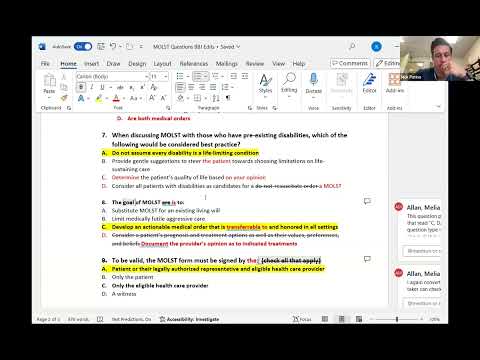
That distinction came after members opened the statute on screen and read the text aloud. One committee member noted the statute lists APRNs and PAs and enumerates elements A through E for provider training; the group concluded the training requirement in statute covers providers and not the full set of potential audiences such as EMS personnel or members of the public.
Committee members said they will still offer training to EMS and other groups because those audiences have expressed an interest and because it supports program goals. Joel, identified in the meeting as the EMS instructional coordinator for state EMS training, and Dr. Kamen were named as subject‑matter experts whose input will guide prehospital training content and format.
Members discussed whether MOLST forms are transferable across state lines; the group agreed to limit claims in educational materials to Connecticut settings unless legal authority supports interstate recognition. One participant recommended wording that MOLST orders are “honored in all settings in Connecticut” rather than implying nationwide transferability.
The committee decided to emphasize in presentations and in a future report to the commissioner that while statute mandates provider education, the advisory group will recommend and provide additional training for EMS, social workers and other non‑statutorily‑listed audiences as part of program implementation.
The subcommittee asked Barbara Cass to post statutes and annotated materials to the shared site and to continue coordinating with EMS staff and the Department of Public Health on the prehospital training plan.
No formal policy change was proposed; the outcome was an administrative clarification and direction to pursue voluntary training for prehospital and public audiences.