Get Full Government Meeting Transcripts, Videos, & Alerts Forever!
Get email alerts on the Training Materials topic
No spam. Unsubscribe anytime.
Advisory panel revises MOLST training quiz to clarify terms, add inclusivity for providers
Summary
A Department of Public Health advisory subcommittee reviewed and edited quiz questions for MOLST training, clarifying acronyms, who may complete the form and disability‑related language, and standardizing answer formats ahead of broader rollout.
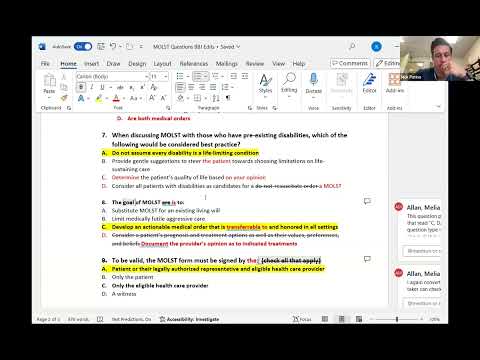
A subcommittee advising the Connecticut Department of Public Health revised the quiz used with MOLST (Medical Orders for Life‑Sustaining Treatment) training, refining question wording, answer choices and disability‑related language to avoid implying disability equals terminal illness.
The changes matter because the quiz will be used in educational materials for providers and potentially for other audiences; the group said clearer wording and consistent answer formats will improve comprehension and reduce misinterpretation.
Members reviewed each question line‑by‑line and proposed edits including using an acronym expansion for “MOLST,” adding “RN” as an option alongside APRN/PA/MD to acknowledge registered nurses, and replacing ambiguous answer choices with precise, legally aligned language. One participant recommended changing question phrasing about disability to make it affirmative: “Do not assume that significant disability always equates to a life‑limiting condition,” a formulation several members endorsed as clearer and less stigmatizing.
The subcommittee also standardized the number of answer options (four per question) where possible, converted inconsistent verb tenses to present tense, and removed conjunctions or filler words that made some answers awkward. They cross‑checked options addressing who may complete a MOLST to ensure the correct choice lists "parent of a minor, guardian appointed by a probate court, or health care representative appointed by the patient" as the legally authorized representatives in the test item under discussion.
Several members suggested small editorial changes: converting passive phrases to active verbs ("documented" to "document"), removing unnecessary commas in multi‑adjective phrases, and ensuring negative‑framed questions were reworded positively to avoid confusion. The group also agreed to remove duplicate answer options and to make distractor answers plausible but incorrect.
The subcommittee said it will save the revised question set and circulate it to the group for final review before sharing it with EMS and other training partners.
The group paused quiz editing to continue other agenda items after agreeing to finalize wording and distribute the updated document for comment.