
Witnesses tell Michigan panel shortage of psychiatric beds—especially for children—forces out‑of‑state placements, strains hospitals and jails
Get AI-powered insights, summaries, and transcripts
Subscribe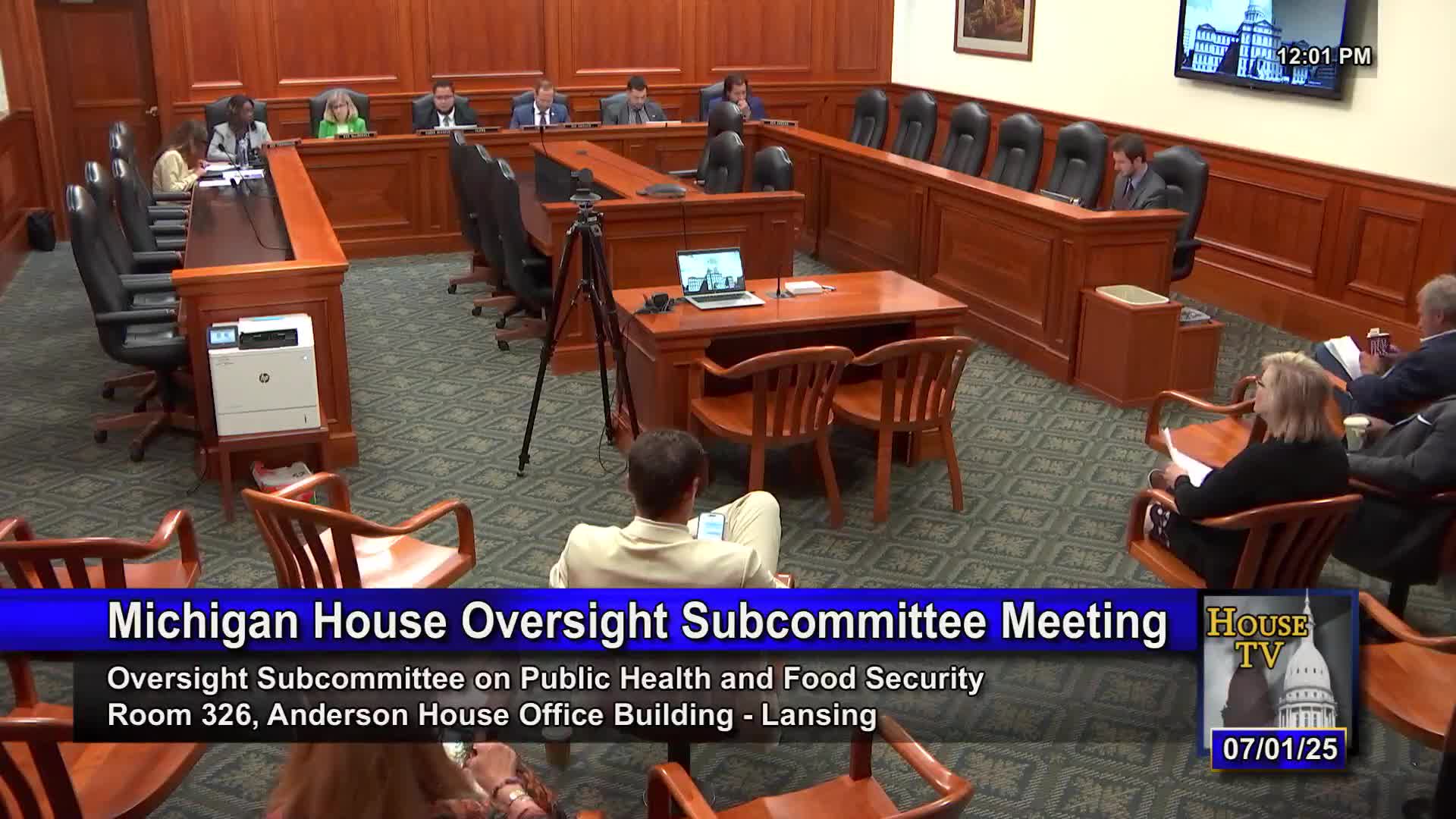
Summary
State and local mental‑health officials, clinicians and first responders told a House oversight subcommittee July 1 that Michigan lacks inpatient psychiatric beds and specialized residential options for children and adolescents, leaving families to rely on emergency rooms, juvenile justice placements and distant out‑of‑state facilities.
The Michigan House Oversight Subcommittee on Public Health and Food Security continued a multiwitness review July 1 of the state’s psychiatric bed shortage, focusing on child and adolescent services and the “continuum of care” that used to follow inpatient treatment.
The shortage matters, witnesses told the panel, because it shifts care from therapeutic settings into emergency rooms, the juvenile justice system and distant out‑of‑state facilities—placing financial, logistical and safety burdens on families, hospitals and county jails.
Mary Anne Huff, president and CEO of the Mental Health Association in Michigan, told the committee that the state no longer has the “robust level of care” that existed in the early 1990s, when two state psychiatric hospitals for children and specialized residential step‑down programs were operating. She said the state lacks licensed specialized psychiatric residential treatment programs on the commercial payer side and that “kids should not have to go into the juvenile justice system to get residential treatment.” Huff said changes in restraint and seclusion rules and shifts in Medicaid policy removed a path that previously let children step down from state hospitals to specialized residential care.
Huff described family calls she receives from parents with children whose behaviors are “extreme,” including self‑harm and violent outbursts, and said families sometimes spend weeks in emergency rooms while waiting for an appropriate bed. She told the committee Michigan currently operates two psychiatric residential treatment facilities (PRTFs) on the private side—one run by Hope Network and another by Pine Rest—but both report full capacity and waiting lists. Huff estimated the state could need “at least 50 to 100” more pediatric/state‑level psychiatric beds if specialized residential care were not expanded; she called for more crisis residential and respite capacity and broader use of Medicaid policy tools such as SED waivers and 1915(b)(3) authorities to expand home‑ and community‑based options.
Steven Burnham, retired Kalamazoo County probate registrar, and Chris Pinter, executive director of Bay Area Community Mental Health, urged lawmakers to consider how financing and governance changes altered local community mental health (CMH) systems. Burnham said CMH funding shifted from a mix that historically included significant county general fund support (he recalled a period around 65% general fund, 35% Medicaid) to a structure that is now predominantly Medicaid (he estimated roughly 90–95% in recent years). He argued that the state “shirked their constitutional statutory duty to provide the entire continuum of care” by closing many state facilities without ensuring backfill services, and he cited a Treatment Advocacy Center report saying Michigan has roughly 18 beds per 100,000 residents and would need roughly 1,000 additional beds to reach a suggested benchmark of about 30 beds per 100,000.
Pinter, whose Bay County CMH provides local services, told the committee that local accountability to county boards and community stakeholders affects how well CMHs meet needs. He said some CMHs regularly overspend Medicaid or general fund allocations to keep people in the community and argued that state funding design and Medicaid coding requirements restrict local flexibility to pay for services that do not fit narrow reimbursement categories.
Clinicians and first responders described how the shortage plays out on the ground. Anne Runyon, a licensed professional counselor with Child and Family Services of Northwestern Michigan, gave a composite account of a 14‑year‑old she called “Laura” who cycled through emergency departments and community services. Runyon said Laura could face a 2½‑hour transport for inpatient placement, that hospitals sometimes lack staff after hours to manage pediatric psychiatric crises and that she knew clients who spent up to 23 days in an emergency room awaiting a bed. “More beds doesn’t just mean more beds,” Runyon said; she added that inpatient capacity brings the ability to provide family groups, meaningful aftercare and local staff to support recovery.
Sarah Bush, a Grand Traverse County Sheriff’s Department case manager who runs jail diversion efforts, reported local corrections data: of 169 people incarcerated in the county jail at the time of her testimony, 38 were diagnosed as severely and persistently mentally ill and 85 had co‑occurring substance use and mental health conditions. Since January, she said, the jail had initiated 12 petitions for inpatient evaluation but secured only seven hospitalizations; securing high‑acuity beds has required officers to accompany patients to distant facilities and has generated “over a hundred and ninety‑seven hours” of overtime. She added that the local Munson psychiatric unit had beds closed for high‑acuity placements and that Northern Lakes Community Mental Health had recently laid off 35 staff.
Panel members and witnesses repeatedly raised process and policy issues: the effects of a 2014 state general fund reduction that Huff and others said reduced local flexibility; the limited reach of private insurers to pay for community living supports or respite; the practical differences between short‑term acute beds in local hospitals and longer‑term state inpatient care requiring specialized staff and longer stays; and a forensic evaluation backlog that a witness said can run five to six months.
No formal votes or committee directives were recorded during the session. The subcommittee heard testimony from other Zoom participants and adjourned after receiving additional public comment.
The witnesses urged several policy approaches that were discussed but not acted on at the hearing: restoring or increasing state support to rebuild a full continuum of care that includes state inpatient capacity and licensed specialized residential treatment; expanding crisis residential and respite services; using Medicaid waivers and general‑fund allocations to fund services for families whose income excludes them from traditional Medicaid; and targeted investment in Northern Michigan to reduce long transports and jail impacts.
The record of testimony, including personal examples and quantitative estimates, will be available in the committee’s transcript for lawmakers weighing funding and regulatory options.