
Massachusetts House adopts $61 billion FY2026 budget conference report
Get AI-powered insights, summaries, and transcripts
Subscribe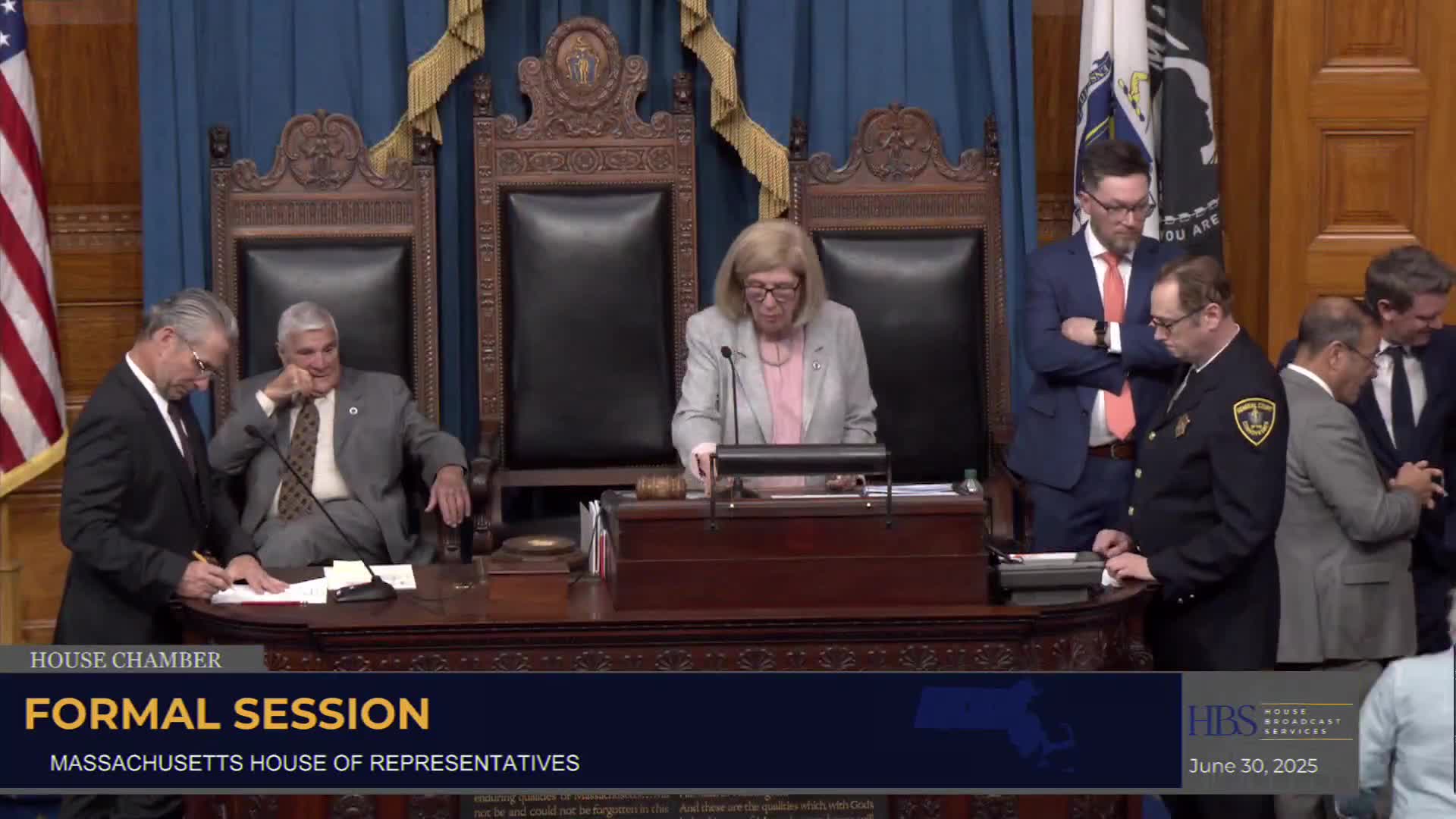
Summary
The Massachusetts House passed the conference committee report on the FY2026 budget, approving a $61 billion spending plan that increases 'fair share' revenue allocations and funds education, transportation, housing and immigration legal assistance programs.
The Massachusetts House of Representatives passed the conference committee report on the fiscal year 2026 budget, approving a roughly $61 billion spending plan that directs increased "fair share" revenue to education and transportation and includes new and expanded funding for housing, food assistance and immigration legal help.
The measure won final passage on a recorded vote after a call of the yeas and nays. The clerk displayed a final tally of 139 votes in the affirmative and 6 in the negative; the clerk then announced, “The conference report is accepted.”
The budget document presented to the chamber shifts $2.4 billion of fair share revenue toward education and transportation and reduces the overall spending level from earlier House and Senate proposals, according to remarks from Representative Michael Wits of Boston, who addressed the chamber on the conference report. "This budget proposal aims to invest 2,400,000,000.0 towards both education and transportation needs," Wits said. He described the package as a $61,000,000,000 plan that "represents a reduction of nearly 1,000,000,000 from House 1, and nearly 500,000,000 below either branch's original bottom line."
Key allocations included in the conference report, as identified during floor remarks and roll-call proceedings: - Chapter 70 education funding: the budget includes $7.3 billion for Chapter 70 and funding to meet the fifth-year obligations of the Student Opportunity Act. - Local aid: the package would bring minimum Chapter 70 aid for cities and towns up to $150 per pupil and totals about $9.5 billion in local aid. - Fair share spending highlights: $360 million for early-childcare and C3 grants (a $475 million total for childcare in FY26), $180 million for permanent universal school meals (an increase of $10 million from the prior year), $80 million to expand financial aid at public higher-education institutions, $24 million for the MassReconnect program for community colleges, and $10 million for Green School Works clean-energy projects at schools. - Transportation: $470 million in direct investments to support the MBTA, which the sponsor said, combined with separately passed supplemental funding, would bring about $1 billion in new investments this month; $150 million for regional transit authorities (totaling about $209 million for RTAs in the package). - Housing and homelessness: $253 million for the Massachusetts Rental Voucher Program (MRVP), $207 million for Rental Assistance for Families in Transition (RAFT), $113 million for the individual homeless shelter line item, and $10 million to support shelter workforce needs. - Food assistance: $50 million for emergency food assistance and $20 million for the Healthy Incentive Program. - Immigration legal assistance: the conference report creates an immigration legal assistance fund with an initial allocation of $5 million.
Representative Wits repeatedly framed the package as fiscally prudent in light of federal uncertainty, saying the conference committee reduced overall spending to "better prepare the Commonwealth for potential economic turmoil in months ahead." Representative Smola of Warren also addressed the chamber and said, "I am proud that we have finally gotten a budget done on time," citing increased stabilization (rainy day) account deposits and a focus on municipal and education needs.
Floor procedure: the final action followed a motion to take the matter by a call of the yeas and nays; court officers opened the roll-call machines for a timed vote as required by House rules. Earlier procedural votes during the session recorded previous steps (passage to be engrossed and passage to be enacted) before the final conference report acceptance.
Discussion versus formal action: floor discussion during adoption focused on allocations and process, per the speakers listed below; the formal action taken was the recorded acceptance of the conference committee report (final passage). The transcript includes several roll-call tallies at different stages of consideration (including earlier tallies reported as 142–0 and 143–1 on prior roll calls for related procedural steps), but the final displayed tally for enactment of the budget was 139–6.
Next steps: after passage in the House, the bill as passed by both branches is sent to the governor for signature or veto, as noted on the floor. The House also adopted the bill's emergency preamble in a separate vote required under the state constitution during the same session.
Ending: Members who spoke in favor emphasized timely completion and targeted investments in education, transportation and housing; opponents recorded on the roll call did not speak at length on the floor during the excerpts in the transcript provided.