
Advocates, crisis lines and lawmakers urge printing 988 on student ID cards to reach youth in crisis
Get AI-powered insights, summaries, and transcripts
Subscribe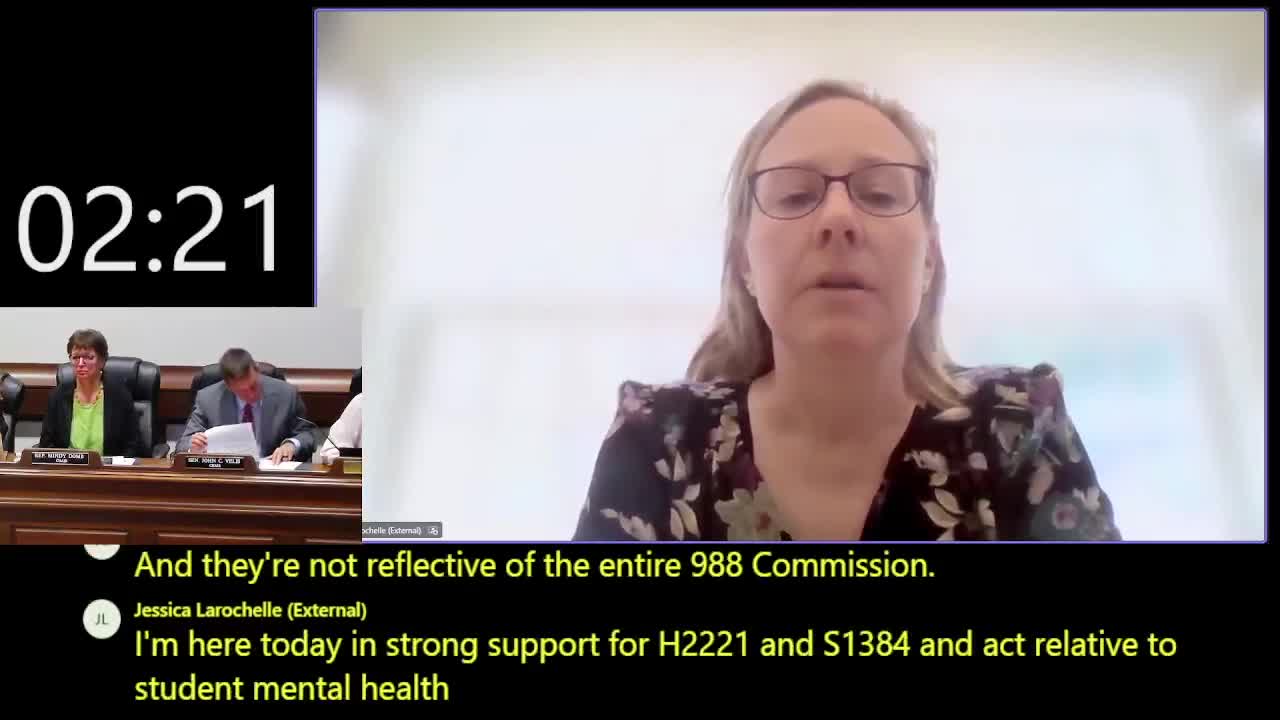
Summary
Witnesses including students, mental‑health advocates and 988 call‑center leaders testified in favor of bills (H.2221/S.1384) that would require public and charter schools to put the 988 suicide and crisis lifeline on student identification cards for grades 6–12 and higher education IDs.
Dozens of testifiers told the Joint Committee on Mental Health, Substance Use and Recovery that adding the 988 suicide and crisis lifeline number to student ID cards would be a low‑cost, high‑reach step to connect young people with crisis counseling.
The House and Senate co-chairs opened remarks and recognized that legislative business required some members to leave for votes. Jacob (Jake) Vitale, a young testifier who said he is a suicide attempt survivor, told the committee that H.2221 and S.1384 are “simple but vital” and that printing 988 on ID cards would raise awareness of the lifeline. “Too many are suffering in silence,” he said.
Jessica LaRochelle, Director of Public Policy at the Massachusetts Association for Mental Health and member of the State 988 Commission, described the bills’ coverage (grades 6–12 and institutions of higher education) and cited state data showing high levels of suicidal ideation among youth. Eileen Davis, director of Call to Talk (the Commonwealth’s largest 988 call center), said 988 connects callers to trained crisis counselors, can prevent emergency‑room or law‑enforcement responses and is already being promoted through posters, buses and outreach. Darcy Lee of Samaritan South Coast said their center answered tens of thousands of 988 calls and that roughly 1,000 calls a year in their region come from people aged 12–24.
Witnesses emphasized three practical benefits: raising awareness of a free confidential resource; normalizing help‑seeking; and making the number immediately available in moments of crisis. Lawmakers asked whether adding the number should be coupled with broader education; witnesses and several committee members suggested pairing printed 988 information with outreach and training in handbooks, student orientations and parent communications.
Multiple states have passed similar laws; proponents asked the committee to report the bills favorably and cited research showing 988’s impact on callers. No formal committee vote was recorded during this hearing.